


Key Points:
- Niacin supplementation counters the shortened lifespan of NAD+-deficient mice.
- A treatment that eliminates age-promoting senescent cells, navitoclax, counters some of the pro-aging effects of NAD+ deficiency, including reduced strength.
- Niacin reverses aging-like features induced by NAD+ deficiency, such as an age-related condition called frailty.
NAD+, a molecule essential for helping maintain healthy tissues, declines with age, particularly in animal studies. These studies raise the possibility that depleted NAD+ contributes to age-related deterioration. However, several recent human studies have shown that NAD+ does not decline with age. Thus, the degree to which NAD+ loss contributes to health and longevity remains unclear.
In a new Nature Communications study, Mayo Clinic researchers tackled part of this question by inducing chronic NAD+ deficiency in genetically engineered mice. By examining these mice, they found that key aspects of age-related deterioration, including a shorter lifespan, arise from NAD+ deficiency alone. Nevertheless, restoring NAD+ with niacin reversed much of this deterioration.
Niacin Counters Shortened Lifespan
To examine how chronic NAD+ depletion affects survival, the researchers followed mice genetically engineered to depend on dietary niacin for maintaining NAD+ levels. In addition to widespread NAD+ depletion, these mice developed a hunched back (kyphosis), gray fur, and cataracts. Remarkably, over roughly six months, mice fed a niacin-free diet had increased mortality, whereas all mice receiving a niacin-containing NAD+-boosting diet survived the observation period.
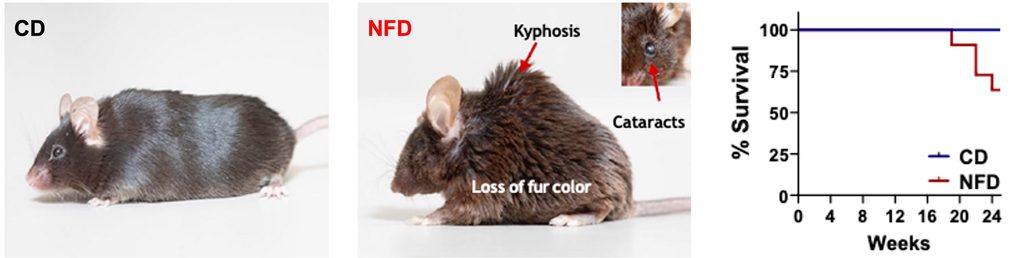
Besides altering the outward appearance of the mice and reducing their survival, NAD+ deficiency induced several additional features of aging. For example, the frailty index—a measure of vulnerability to disability, disease, and death—was higher in the NAD+-deficient mice. Moreover, the NAD+-deficient mice weighed less, probably due to reduced muscle and bone mass. They also exhibited poor physical performance, such as limited endurance, and metabolic defects, such as high blood glucose levels.
Eliminating Senescent Cells Improves Strength
The researchers went on to measure traditional markers of tissue aging from NAD+-deficient mice, young mice, and aged mice. They found that markers of inflammation and oxidative stress—which is when antioxidants fail to protect against reactive oxygen species (ROS)—were elevated in both NAD+-deficient and aged mice. Both groups of mice also had high levels of senescent cells—cells that can accumulate throughout the body with age, damage tissue, and spread inflammation.
The researchers found that niacin treatment reduced inflammation, oxidative stress, and senescent cell markers. Furthermore, to investigate the pro-aging effects of senescent cells, the researchers treated the mice with a compound that directly eliminates senescent cells called navitoclax (ABT263). Surprisingly, navitoclax treatment improved the grip strength and reduced the frailty index score of the NAD+-deficient mice. These findings suggest that senescent cells contribute to the pro-aging effects of NAD+ deficiency.

Niacin Reverses Features of Aging in NAD+-Deficient Mice
Niacin, a form of vitamin B3 that boosts NAD+, reversed many of the aging-like changes that developed in the NAD+-deficient mice. To test this, the NAD+-deficient mice were given a niacin-containing diet [control diet (CD] for six weeks following 15 weeks of the niacin-free diet. Restoring niacin replenished NAD+ across multiple tissues, and the mice became less frail and regained body weight.
Moreover, compared to mice that remained niacin-deprived, the niacin-treated mice ran longer and farther on a treadmill. Their blood glucose levels returned toward normal, and their bone mass was improved. In the liver, 3,409 of the 3,695 genes altered by NAD+ deficiency were no longer altered, indicating that much of the molecular disruption was reversible.
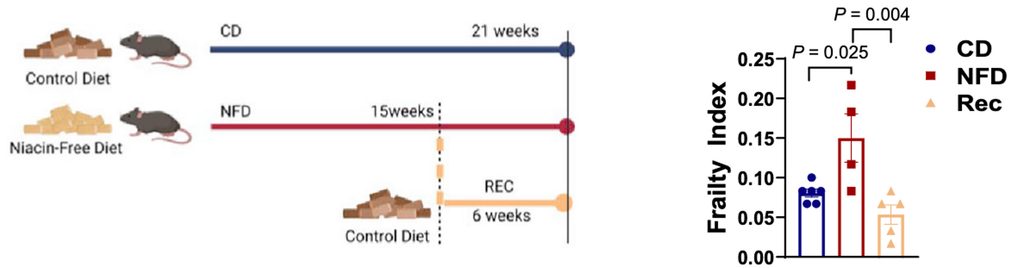
Importantly, this was a reversal of deficiency-driven NAD+ decline, not proof that niacin reverses normal aging. The NAD+-deficient mice were genetically engineered to depend on dietary niacin, and their condition reproduced only some features of aging. Overall, the experiments also did not establish that niacin restored total lifespan or would produce similar benefits in people without a deficiency.
Assuring NAD+ Levels Will Not Decline with Age
The study suggests that NAD+ deficiency, in the form of niacin deficiency, may contribute to features of biological aging. However, NAD+ deficiency, caused by a lack of dietary vitamin B3 (niacin) or tryptophan, was largely eradicated in the 1940s. Today, pellagra, a condition caused by NAD+ deficiency that leads to diarrhea, dementia, dermatitis, and death, is exceedingly rare. Moreover, new evidence suggests that NAD+ levels do not decline with age in healthy individuals.
It follows that maintaining NAD+ levels with age may not be that difficult. It’s possible that regular exercise and a diet rich in foods that contain vitamin B3, such as meat (e.g., poultry, beef, and seafood) or fortified cereals and breads, may suffice. Nevertheless, supplementing with an NAD+ precursor like niacin can also help maintain NAD+ levels with age.
 Comments