


Key Points:
- Semaglutide extends the lifespan of aged mice by over 12% and improves physical performance.
- The anti-obesity drug also counters memory loss and promotes the formation of new neurons in aged mice.
- Semaglutide appears to mimic caloric restriction, which has historically been the most powerful longevity intervention in animal studies.
Caloric restriction (CR) has drawn intense interest from geroscientists—researchers who study the biology of aging and ways to delay age-related disease—because it remains one of the most robust lifespan-extending interventions in lab animals. Nevertheless, most people find it difficult to consistently consume fewer calories. For this reason, geroscientists are actively exploring alternatives, such as dietary supplements and repurposed drugs, that mimic CR’s health and longevity effects.
In a new study published in Nature, researchers from the University of California, Berkeley found that semaglutide does more than mimic CR’s effects: it enhances them. They also found that semaglutide improves health while influencing several biological processes linked to aging, including NAD+ depletion and the accumulation of senescent cells. The findings raise the possibility that semaglutide could help delay aspects of biological aging and extend lifespan—though whether these effects translate to longer, healthier lives in people remains to be determined.
Semaglutide Extends Lifespan & the Drive to Move
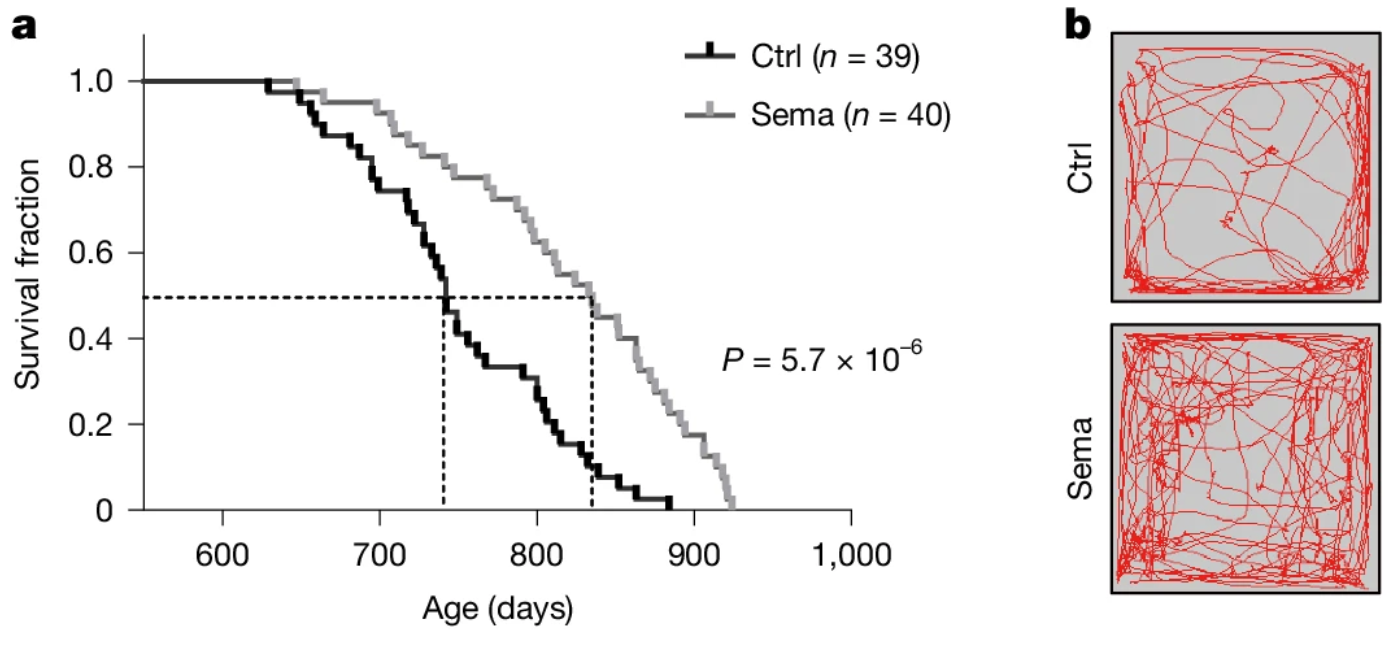
The mice began receiving semaglutide when they were roughly equivalent in age to 60-year-old humans (20 months old). Daily injections (10 nmol/kg) of semaglutide led to a 12.4% increase in median lifespan. Moreover, the aged mice treated with semaglutide performed better on feats of strength, coordination, and endurance: they stayed balanced longer on a rotating rod, clung longer to an inverted wire mesh, and ran longer on a treadmill before reaching exhaustion. Semaglutide also increased locomotor and exploratory activity when the aged mice were free to roam, suggesting a stronger drive to move about.
Semaglutide Improves Neurogenesis and Memory
The hippocampus, a brain region involved in forming memories, houses neural stem cells, which are capable of becoming brain cells, such as neurons. The generation of new neurons, called neurogenesis, from neural stem cells contributes to the formation of new memories. With aging, neurogenesis declines, contributing to cognitive deficits, like memory loss. Moreover, neurogenesis is disrupted in neurodegenerative disorders like Alzheimer’s disease.
The researchers found signs of cell division and new neurons in the hippocampus of aged mice treated with semaglutide, suggesting that GLP-1 receptor (GLP-1R) activators promote neurogenesis. Supporting this notion, semaglutide also improved the performance of aged mice on learning and memory tests, such as the Barnes Maze. This test involves the mice learning to remember an escape hole in the target quadrant of a large table-like structure. The semaglutide-treated aged mice searched more holes in the target quadrant than normal.
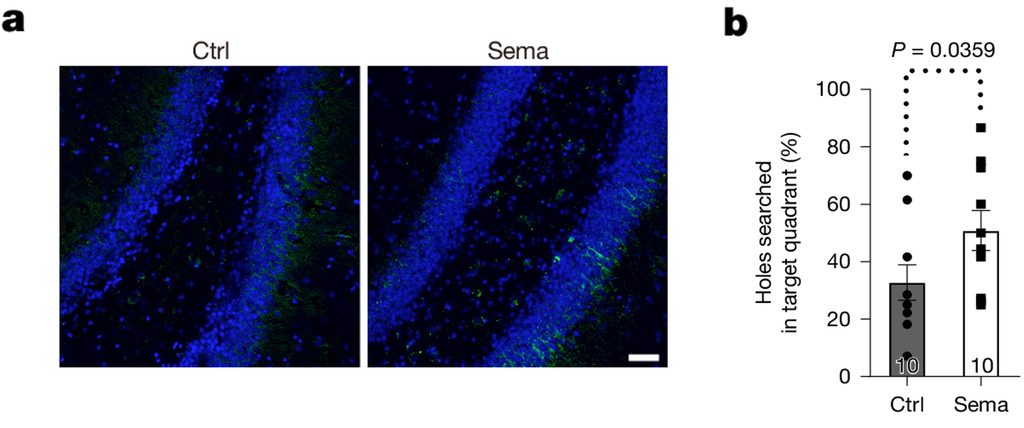
The researchers also found that semaglutide influenced several biological processes associated with aging. Treatment lowered blood glucose, increased NAD+ levels, and reduced inflammatory signaling. It also decreased markers of cellular senescence—a state in which damaged cells remain metabolically active, accumulate with age, and promote tissue dysfunction and chronic disease. Together, these results suggest that semaglutide may act on multiple underlying drivers of aging, rather than affecting feeding preferences alone.
Semaglutide Enhances Caloric Restriction
The Berkeley researchers found that semaglutide reduced the aged mice’s food intake by 24%. To compare semaglutide treatment to CR, they calorically restricted (reduced the food intake) the diet of another group of age-matched mice by 24%. While both groups consumed the same amount of food, each exhibited different feeding patterns. The calorically restricted mice consumed all their food as soon as it was available, fasting until the next day. In contrast, the semaglutide-treated aged mice ate throughout the day, consistent with the appetite-suppressing effects of GLP-1R activators.
Both groups of mice lost similar amounts of weight, particularly from fat loss, and performed similarly well on tests of strength, coordination, and endurance. Notably, the semaglutide-treated aged mice performed better on the Barnes maze test, suggesting enhanced memory improvements. Semaglutide also showed better trajectories for blood glucose levels and moved around more when brought into open spaces.
“These findings indicate that GLP-1R activation late in life recapitulates many functional benefits of calorie restriction by attenuating age-associated decline, while conferring additional benefits in exploratory drive, spatial memory and glucose control, suggesting effects beyond reduced calorie intake alone,” said the authors of the study.
Longevity Expert Dr. Matt Kaeberlein Points Out Major Caveat
In a post on X, Dr. Matt Kaeberlein compared the Berkeley survival data with results from earlier mouse lifespan studies, including a landmark experiment in which CR extended lifespan. His overlay suggests that untreated mice in the Berkeley study died substantially earlier than the control mice in that earlier CR study.
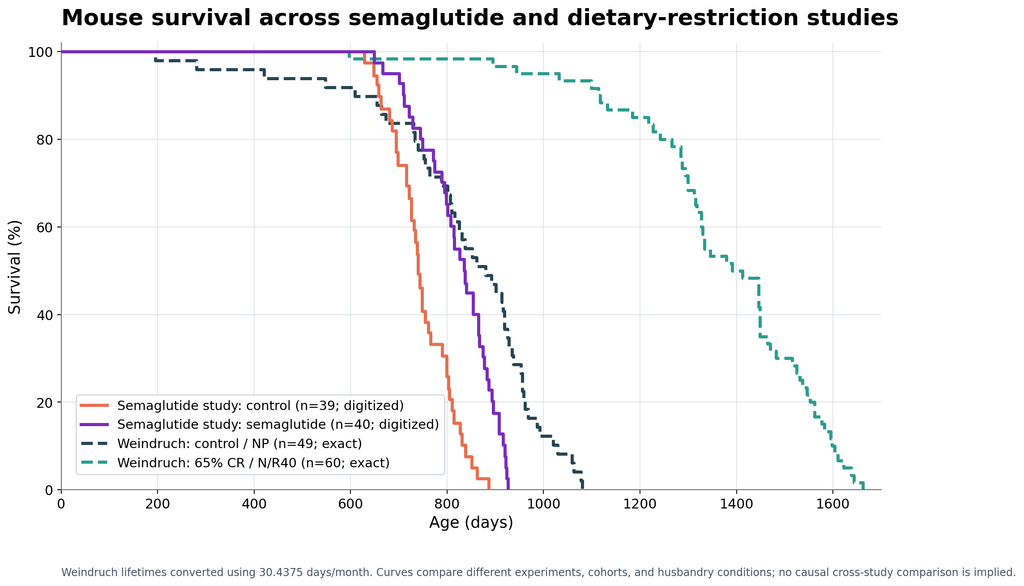
The comparison raises an important caveat: semaglutide’s reported lifespan benefit may partly reflect unusually short-lived controls rather than an effect comparable to the robust longevity benefits historically reported for CR. Cross-study comparisons have inherent limitations, however, because mouse strain, diet, housing, husbandry, and other experimental conditions can strongly affect survival. Still, the available data do not show that semaglutide reproduces the magnitude of CR’s lifespan-extending effects in mice.
 Comments