


Key Points:
- Glycine extends the lifespan of fruit flies on a normal diet and a high-fat diet by over 19% and 44%, respectively.
- The amino acid counters signs of liver, muscle, brain, and metabolic aging in rats.
- Glycine extends lifespan and counters aging, likely due to increasing natural antioxidants and enhancing mitochondrial health.
What we consume each day profoundly affects how fast we age. Our diet represents one of the most potent modulators of aging under our control. However, our metabolism changes with age, potentially necessitating higher doses of certain nutrients that cannot be achieved through diet alone. One of these nutrients may be glycine, an amino acid naturally synthesized by the body.
While not an essential amino acid, glycine deficiency can occur under conditions of high metabolic demand, such as with pregnancy or metabolic diseases. Supporting this notion, low circulating glycine has been observed in diseases like obesity, muscle decline (sarcopenia), and heart disease. It follows that supplementation may restore glycine levels and counter these diseases and other aspects of aging.
To explore this, researchers from Harbin Medical University in China studied the effects of glycine on aging flies and rats. In a new study published in Free Radical Biology and Medicine, they show that glycine extends the lifespan of flies. They also show that glycine counters multiple aspects of aging in rats, including brain and muscle aging. These findings suggest that restoring glycine levels may contribute to slowing the progression of aging and delaying the onset of disease.
Glycine Extends Fly Lifespan
For their experiments, the Harbin Medical University researchers compared a regular diet (RD) with a high-fat diet (HFD). The HFD was used to increase metabolic demand, trigger metabolic stress, and accelerate aging.
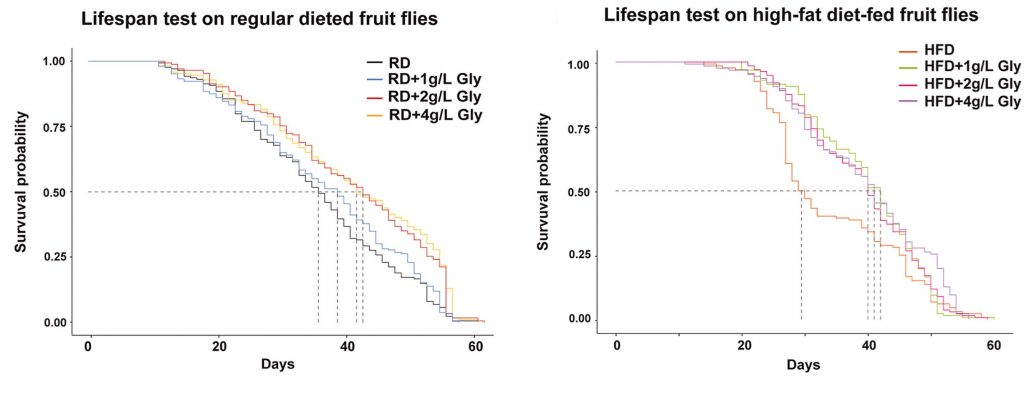
To assess lifespan, the researchers chose the fruit fly, an animal that lives less than 60 days. Initially, the flies fed a HFD had lower glycine levels than the flies fed a RD, suggesting the metabolic demand of the HFD depletes glycine. Subsequently, the flies were separated into groups and given different doses of glycine across their short lifetimes. Interestingly, the researchers found that glycine extended lifespan in HFD-fed flies more significantly than in RD-fed flies, reflecting the initial glycine levels.
Specific Lifespan Extension Values
The extension in median lifespan (the age at which half the group has died and half remains alive) for each group of flies were as follows:
RD-fed Fruit Flies:
- 1 g/L of glycine: no increase
- 2 g/L glycine: 19.4% increase
- 3 g/L glycine: 16.7% increase
HFD-fed Fruit Flies:
- 1 g/L of glycine: 44.8% increase
- 2 g/L glycine: 37.9% increase
- 3 g/L glycine: 41.4% increase
Glycine Counters Aspects of Aging in Flies
As fruit flies age, their ability to climb declines. The researchers found that glycine supplementation improved the climbing ability of aged flies, suggesting it counteracts physical aging. Glycine also lowered blood triglyceride and total cholesterol levels in all flies, suggesting improvements in metabolic health. Moreover, glycine delayed the onset of death when the flies were starved, suggesting protection against starvation-induced stress. These results could be attributed to an increase in natural antioxidants, which glycine induced in all flies.
Glycine Counteracts Aspects of Aging in Rats
Glycine has previously been shown to extend the median lifespan of mice by about 6%. Moreover, when combined with the amino acid N-acetylcysteine, glycine was shown to extend the lifespan of mice by about 24%. In both studies, the extension in lifespan was attributed to an increase in natural antioxidants and the enhancement of mitochondrial health.
To determine the effects of glycine on aging rats, the researchers fed glycine to middle-aged rats each day across the remainder of their lifetime. While a lifespan experiment was not conducted, they found that glycine supplementation reduced the rats’ mortality rates.
Glycine Counters Aspects of Muscle, Liver, Brain, & Metabolic Aging
Furthermore, glycine reduced liver size and increased muscle size and grip strength. Markers of liver damage were also reduced, along with lower triglyceride and total cholesterol levels. Paralleling other experiments, glycine was shown to increase natural antioxidants like glutathione, considered our master antioxidant, and SOD (superoxide dismutase), our main mitochondrial antioxidant.
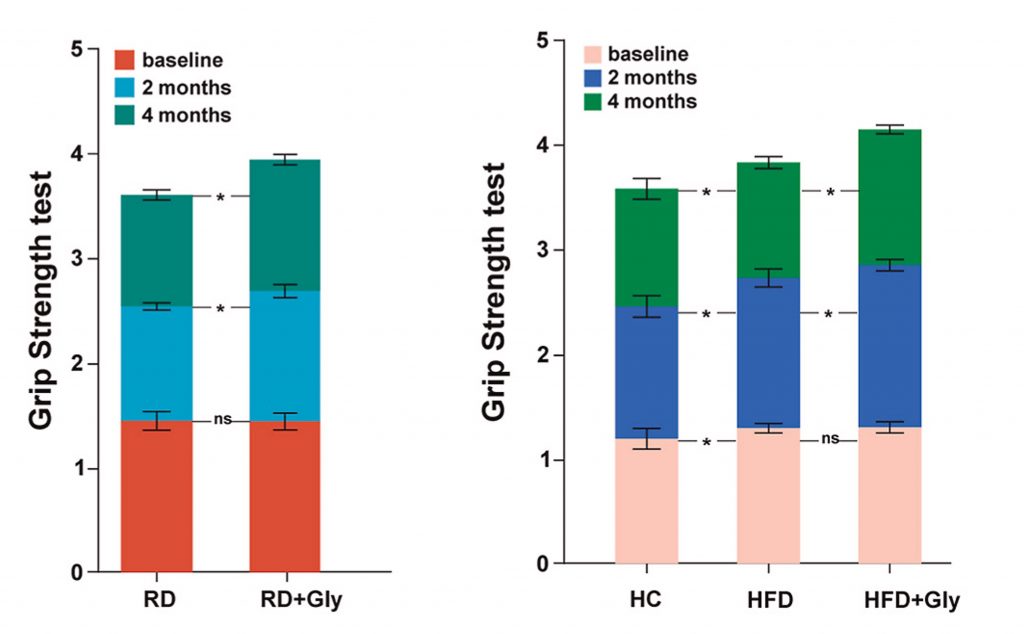
The Harbin researchers also examined a region of the brain called the hippocampus, which contributes to memory formation. They observed damaged neurons that were shrunken and exhibited DNA abnormalities. They also observed abnormalities in the liver and muscle. These signs of degeneration were mitigated by glycine supplementation, regardless of whether the rats were fed a RD or a HFD. Together, these findings suggest that glycine mitigates multi-organ aging.
Glycine Mitigates Mitochondrial Dysfunction
Through the genetic manipulation of flies, the researchers found the lifespan-extending effects of glycine to be dependent on the increased activation of a gene called Nmdmc. What’s more, the mouse version of the same gene, called Mthfd2, was elevated by glycine in the liver and muscle of aged rats. Studies show that the Nmdmc/Mthfd2 gene promotes improvements in mitochondrial health.
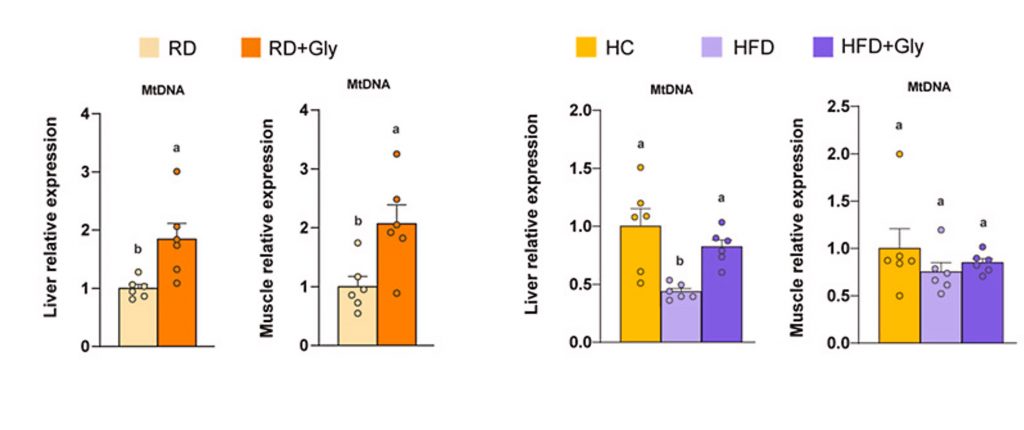
Supporting the role of mitochondria, the researchers found that glycine increased genes associated with mitochondrial biogenesis—the generation of new mitochondria—in the aged rats. Mitochondria have their own DNA, and when new mitochondria are formed, the mitochondrial DNA is copied. The researchers found that glycine increased the mitochondrial DNA copy number, further suggesting increased biogenesis. Since biogenesis helps to maintain mitochondrial function, these findings suggest that the lifespan-extending effects of glycine could, in part, be due to improvements in mitochondrial health.
Can Glycine Increase Our Lifespan?
There exists a lack of clinical evidence suggesting that glycine extends the lifespan of humans. Still, based on studies showing that low circulating glycine correlates with metabolic diseases, it may be possible for some individuals. Namely, glycine supplementation may improve the health and longevity of individuals with low glycine levels. An amino acid blood panel from a healthcare professional can measure circulating glycine levels to determine whether they are low.
How to Increase Glycine Levels
Glycine is considered the most important non-essential amino acid. As such, it may be beneficial to supplement with glycine or consume more protein. Proteins are made of chains of amino acids, including glycine, and collagen proteins are composed of high levels of glycine. Therefore, consuming foods with collagen, like bone broth or meat, may support higher glycine intake compared to other foods containing protein. The supplement form of glycine is also widely available and inexpensive. Still, the body synthesizes its own glycine, and this synthesis does not appear to decline until the latter stages of life.
 Comments