


Key Points:
- NR elevates blood NAD+ levels more than NMN, but neither elevates brain NAD+ levels after 8 days of supplementation.
- After 4 weeks of supplementation, NR raises brain NAD+ levels in healthy individuals but not in Parkinson’s disease patients.
NAD+ is a natural molecule, vital for cellular health, that declines with age in organs such as the skin, liver, and brain. According to animal studies, NAD+ decline contributes to a host of chronic conditions, including heart disease and neurodegenerative disorders like Parkinson’s disease (PD). However, NAD+ precursors like NR and NMN can replenish NAD+ and counteract these chronic conditions, even prolonging the lifespan of mice.
However, while animal studies suggest that NAD+ precursors counteract aging, there are fewer studies exploring their effects on human subjects. And when it comes to the nervous system, questions remain concerning the effectiveness of NAD+ precursors in replenishing NAD+ levels in the brain. Thus, as seen in a new study published in iScience, Norwegian scientists explored the time-dependent effects of NR and NMN on NAD+ levels in the blood and brain.
NR Raises Blood NAD+ Levels More Than NMN
The Norway-based scientists conducted their study in two stages. In the first stage, 6 healthy middle-aged adults (3 men & 3 women) were given 1200 mg/day of NR or NMN for 8 days. During these 8 days, blood NAD+ levels gradually increased in response to both NR and NMN. Interestingly, however, NR led to a 2.3-fold higher increase in blood NAD+ levels than NMN.
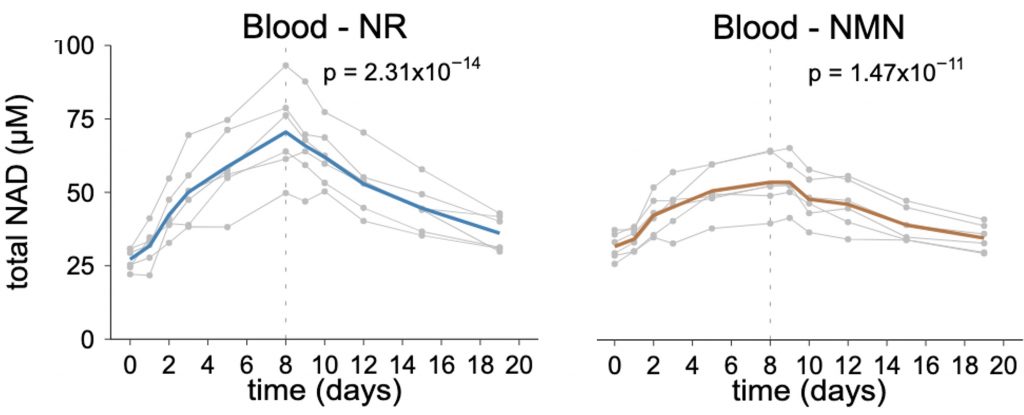
In the same participants, the researchers measured brain NAD+ levels using an MRI (magnetic resonance imaging) machine. They found that neither NR nor NMN raised NAD+ levels in the brain during 8 days of supplementation. These findings suggest that while NR raises blood NAD+ levels more than NMN, this does not reflect NAD+ levels in the brain, and possibly other tissues and organs.
NR Raises Brain NAD+ Levels
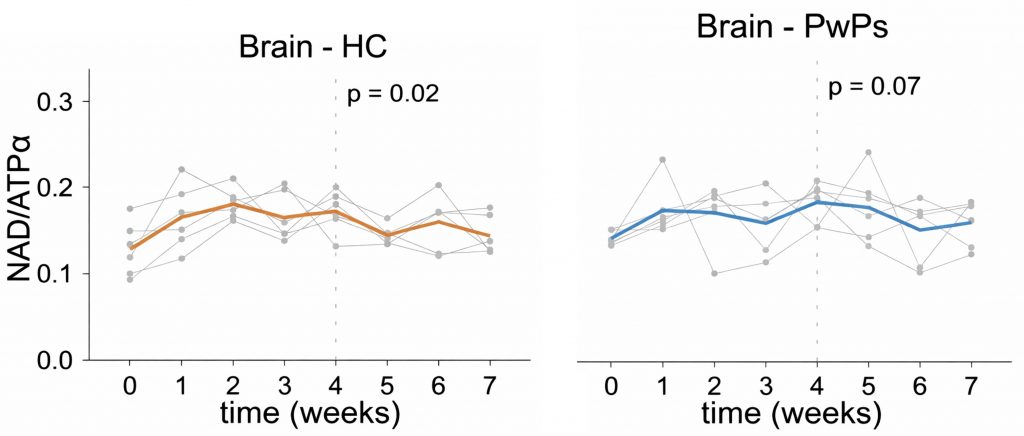
After finding that 8 days of NAD+ precursor supplementation does not increase brain NAD+ levels, the researchers extended the treatment period to 4 weeks in the second stage of their study. Additionally, having found that NR increases blood NAD+ levels more than NMN, they conducted the second stage of their study with only NR. This time, the participants were 6 healthy middle-aged adults (3 men & 3 women) and 6 PD patients (3 men & 3 women).
The results showed that blood NAD+ levels stabilized after 2 weeks in all participants. In the brain, NR significantly increased NAD+ levels in the healthy participants. A similar trend was observed in the PD patients, but the increase was just shy of statistical significance. Notably, the healthy participants and PD patients had similar resting levels of brain NAD+, suggesting that PD does not lead to NAD+ brain depletion. However, larger studies, with more than 6 participants and a placebo group, are needed to support this notion.
Elevating NAD+ for Healthy Brain Aging
The brain is the highest consumer of cellular energy, consuming about 25% of the total available energy. This cellular energy, called ATP (adenosine triphosphate), is primarily produced by our mitochondria. NAD+ mediates the generation of ATP by delivering electrons within mitochondria. Thus, insufficient NAD+ levels may hinder the production of ATP, leading to defects that promote cellular aging. When it comes to the brain, this energetic failure can lead to neuronal abnormalities that promote cognitive impairment, dementia, and neurodegeneration.
In a previous study, the Norwegian scientists showed that NR increases brain NAD+ levels in PD patients, which was associated with alleviating the motor symptoms of PD. This study included a placebo group, with 13 participants in the NR group and 14 in the placebo group, demonstrating that larger studies may more accurately assess the beneficial effects of NAD+ on the brain. The study suggests that elevating brain NAD+ levels can counteract age-related neurological conditions like PD.
Still, the Norwegian researchers emphasize the variability in brain NAD+ levels between participants. Studies suggest that NAD+ levels are modulated by physical activity and diet, which may account for the wide range of brain NAD+ levels observed. It follows that taking an NAD+ precursor for brain health may be more beneficial for overweight and obese individuals, as well as sedentary individuals.
When it comes to the duration of treatment, it’s possible that 4 weeks of supplementation is not necessary. In a previous UPenn study, researchers utilized a more powerful MRI machine to determine that 900 mg of NR raises brain NAD+ levels within 4 hours. However, depending on the participant, NAD+ levels increased by 7 to 40%, again showing the variability between individuals. Still, on average, brain NAD+ levels increased by 16%, suggesting that taking NR, or possibly NMN, can increase brain NAD+ within hours.
Once the complexity of interindividual differences in brain NAD+ levels is worked out, we may soon see NAD+ precursors as a therapeutic option for age-related brain conditions, such as cognitive impairment, neurodegeneration, and dementia.
 Comments