


Key Points:
- Combining NMN (nicotinamide mononucleotide) with human umbilical cord–derived stem cells reduced signs of immune aging, including the shrinkage of two immune system organs—the thymus and spleen.
- Cell experiments suggested that NMN helps preserve stem cell function by reducing the effects of oxidative stress, where reactive molecules overwhelm cellular antioxidant defenses, protecting against senescence.
- The combination generally showed greater benefits than either treatment alone, but the findings remain preclinical, and human trials still need to establish effectiveness against natural aging and immune decline.
As published in Mechanisms of Ageing and Development, scientists from China Pharmaceutical University provide data showing that NMN enhances stem cell therapy to alleviate declining immunity in a mouse model of aging. The stem cell therapy, which is gaining attention among researchers, uses human umbilical cord-derived mesenchymal stem cells (hUC-MSCs), stem cells that are isolated from human umbilical cords.
In addition to enhancing these cells’ ability to alleviate declining immunity, the scientists found that NMN and hUC-MSC therapy improved motor and cognitive function. Also, in the spleen and thymus, the combination alleviated cellular senescence (a dysfunctional state where cells permanently stop dividing and can release inflammatory molecules). In laboratory dishes, NMN protected hUC-MSCs from oxidative stress and mitigated hUC-MSC senescence, thereby preserving the stem cells’ anti-aging properties. These findings suggest that adding NMN to hUC-MSCs helps maintain the stem cells’ function and enhances their effects against aging.
“Taken together, our study provides a promising combinatorial approach that sustains stem cell function and amplifies anti-ageing efficacy,” say the scientists in their publication.
Background on Human Umbilical Cord-Derived Mesenchymal Stem Cell Therapy
hUC-MSCs are cells isolated from umbilical cord connective tissues, usually Wharton’s jelly—a gel-like material surrounding the cord’s blood vessels. They can multiply, develop into certain connective tissue cell types, and release signals that influence inflammation and tissue repair.
Researchers are investigating hUC-MSC therapy against immunosenescence (an age-related remodeling and deterioration of immune function), but this remains experimental rather than an established immune rejuvenation treatment. Moreover, hUC-MSC therapy can combine multiple protective actions, such as reducing excessive inflammatory activity and protecting immune organs from damage, in the presence of persistent, age-related inflammation, to enhance immunity during aging.
Combining NMN with the Stem Cells Enhances Their Effects Against Aspects of Aging
To assess the effects of combining NMN with the hUC-MSCs on aspects of aging, the scientists employed a D-galactose mouse model of aging. In this model, mice repeatedly receive a high dose of D-galactose, a simple sugar that promotes massive levels of oxidative stress, to induce aging-like changes over the course of weeks. The model reproduces several features associated with aging besides oxidative stress, including inflammation and impaired tissue function.
To assess whether NMN enhances hUC-MSC therapy against aspects of motor and cognitive aging, the scientists administered 100 mg/kg/day of NMN in drinking water for eight weeks and hUC-MSCs once weekly during weeks five through seven. A series of behavioral tests helped the scientists measure the combination’s effects on age-related motor and cognitive deterioration.
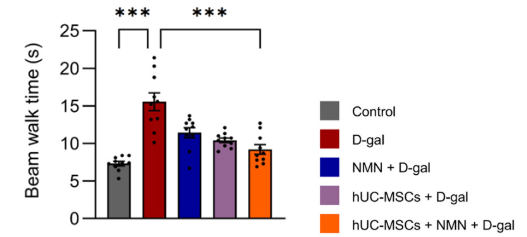
In a behavioral test of motor coordination, where mice use balance and fine motor coordination to cross a narrow, elevated beam to a safe platform, either NMN or hUC-MSC therapy alone attenuated age-related impairments, as shown by reduced times to cross the beam. The combined treatment, however, significantly reduced times to cross the beam. These results suggest that NMN enhances hUC-MSC therapy’s capability to improve age-related impairments in balance and fine motor coordination.
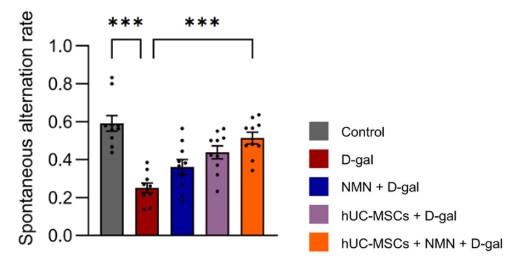
In another behavioral test used to assess memory, where a mouse explores a three-armed apparatus shaped like the letter Y, researchers tracked and recorded the sequence of arm entries. Healthy mice with intact memory tend to explore a recently visited arm rather than repeatedly returning to the same locations, indicating that they remember where they have been. In their experiment using this test, the Chinese scientists found that either NMN or hUC-MSC therapy trended toward improving memory impairments. The combination of these treatments significantly enhanced this effect, suggesting that combining them significantly improves the benefits to memory from either treatment on its own.
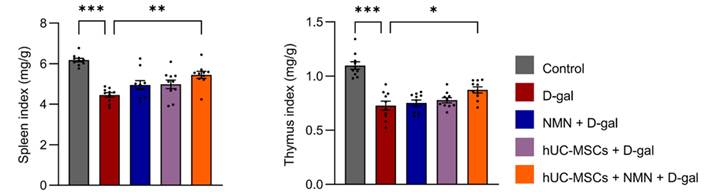
Immunosenescence is an important aspect of aging, since age-related changes in immune function affect protection against contributors to aging, like infections, impaired tissue repair, and uncontrolled inflammation. The scientists therefore evaluated the protective effects of NMN and hUC-MSC therapy on the spleen and thymus, two crucial organs involved in immunity. Age-related thymus shrinkage and deterioration of the spleen’s structure disrupt coordinated immune responses, so the researchers measured the treatments’ effects on thymus and spleen sizes. They found that the combination of NMN and hUC-MSC therapy worked significantly better than either treatment on its own at increasing the size of both organs, suggesting that NMN enhances hUC-MSC therapy’s effects against immunosenescence.
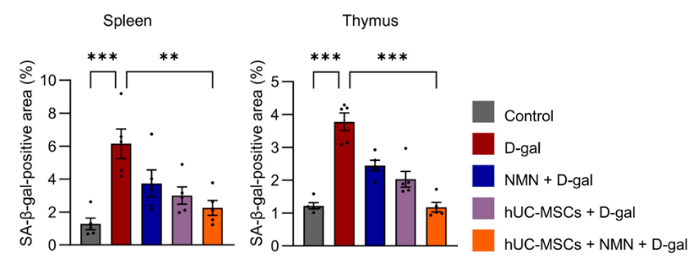
Cellular senescence in the spleen and thymus can contribute to immunosenescence. For this reason, the scientists measured how NMN and hUC-MSC therapy influenced a protein marker of cellular senescence in these organs. They found that the combination of the two therapies significantly lowered protein levels of the cellular senescence marker in both organs, while either treatment on its own only trended toward lowering the cellular senescence marker. These results suggest that NMN enhances hUC-MSC therapy’s effects at alleviating immunosenescence by reducing cellular senescence in the spleen and thymus.
To unravel how NMN enhances hUC-MSC therapy’s effects against immunosenescence and other aspects of aging, like memory and motor deterioration, the scientists treated hUC-MSCs in a laboratory dish with an oxidative stress-inducing molecule (hydrogen peroxide) that induces cellular senescence. Along these lines, oxidative stress can induce cellular senescence when it causes persistent damage that the cell cannot adequately repair.
Treating hUC-MSCs with hydrogen peroxide significantly increased protein markers of senescence. However, adding NMN to the hydrogen peroxide-treated hUC-MSCs significantly suppressed the levels of protein markers of senescence. This finding suggests that NMN enhances the resistance of hUC-MSCs to oxidative stress, thereby mitigating their entry into senescence. This may enhance the efficacy of hU-MSC therapy against immunosenescence, thereby alleviating aspects of aging, such as impaired motor function and memory.
“Collectively, our findings support the combined use of hUC-MSCs and NMN as a promising anti-ageing intervention, demonstrating a tendency toward greater therapeutic benefit than either treatment alone,” say the scientists in their publication. “In this combinatorial strategy, NMN contributes not only through its intrinsic anti-ageing properties but also by preserving MSC functionality.”
Improving Stem Cell Therapy with NMN
Combining NMN with hUC-MSC therapy may offer a way to support the stem cells to enhance their anti-aging properties. In this study, the combination reduced senescence-associated changes in the spleen and thymus and improved motor coordination and memory-related performance in the D-galactose-treated mouse model. Cell experiments also suggested that NMN helps protect the stem cells from oxidative stress, which can suppress their entry into cellular senescence and possibly improve their functional capacity.
However, these findings do not establish that the combination reverses immune aging in people. The researchers used a chemically induced mouse model and laboratory-grown cells, and did not test whether treatment improved specific aspects of immunosenescence, such as resistance to infection, or, importantly, lifespan. Further studies in naturally aged animals testing whether the combination improves specific facets of immunosenescence and lifespan, followed by carefully controlled human trials, would be needed to assess the combination’s clinical potential. For now, the study highlights a promising principle: improving a cell therapy may require protecting the cells delivering it with compounds, like NMN, that have antioxidant properties.
 Comments