


Key Points:
- Compared to older adults without frailty, frail older adults had lower levels of whole-blood NAD+.
- An analysis showed that as blood NAD+ levels increase, the odds of frailty decrease.
- In another recent study, Italian researchers propose a set of supplements that may counter frailty and other age-related diseases involving muscle loss.
Maintaining our body during the earlier stages of life may delay or prevent frailty, a syndrome characterized by weight loss, weakness, exhaustion, slow gait, and lack of physical activity. In a new study published in Geroscience, Japanese researchers showed that low NAD+ levels are associated with frailty in older adults. Still, whether maintaining NAD+ levels throughout life can delay or prevent frailty remains an open question.
Low NAD+ Levels in Frail Older Adults
To better understand the biological features of frailty, the Japanese researchers recruited 529 adults aged 65 and older from Tokyo’s Itabashi Ward. They assessed frailty using five criteria: unintentional weight loss, low grip strength, self-reported exhaustion, slow gait speed, and physical activity no more than once per week.
Participants who met at least three of these criteria were classified as frail. About 6% of the cohort met that definition. The researchers found that, compared with robust participants, those classified as frail were older and had lower muscle mass, weaker grip strength, and slower walking speeds. Blood analyses also showed that frail participants had significantly lower NAD+.
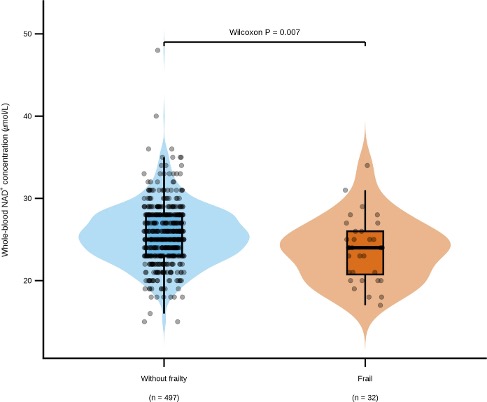
The Odds of Frailty Increase as NAD+ Levels Decrease
To further determine how blood NAD+ levels are associated with frailty, the researchers ran an additional analysis. They found that for every 1 µmol/L increase in NAD+, the odds of frailty decreased by about 13%. Overall, they showed that the odds of frailty decreased as whole-blood NAD+ levels increased. These findings suggest that low NAD+ levels contribute to frailty or that frailty contributes to low NAD+ levels.
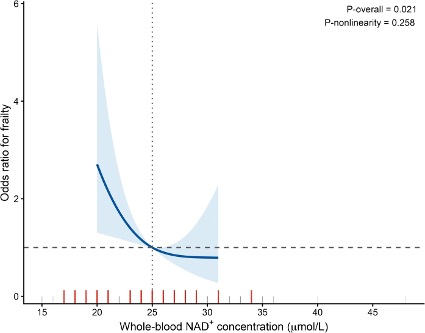
Taking an NAD+ Supplement to Delay or Prevent Frailty
NAD+, an essential molecule found in all our cells, mediates the production of cellular energy and protects cells against biological stress. Animal studies have shown that low NAD+ levels are associated with multiple age-related diseases, and restoring NAD+ mitigates these diseases. NAD+ precursors, including nicotinamide mononucleotide (NMN) and nicotinamide riboside (NR), are commonly used to replenish NAD+ levels in these studies.
However, the authors of the study are careful to say,
“Importantly, an increase in whole-blood NAD⁺ concentration does not necessarily indicate restoration of skeletal-muscle or other tissue-specific NAD⁺ pools, and it has not been established that increasing whole-blood NAD⁺ concentration prevents or improves frailty. Therefore, the present findings should be regarded as hypothesis-generating and should not be interpreted as supporting NAD⁺ precursor supplementation for frailty.”
Taking Multiple Supplements to Delay or Prevent Frailty
In another recent study, published in Dietetics, Italian researchers proposed a set of nutraceuticals that may counter frailty and related diseases. Their focus was on muscle, which tends to atrophy with age while also becoming more difficult to maintain or grow. As such, the nutraceuticals the Italian researchers mention also target sarcopenia, an age-related disease characterized by muscle mass and strength loss.
Boosting Mitochondria to Build Muscle
To function optimally, our energetically demanding muscles require ample levels of cellular energy, known as adenosine triphosphate (ATP). However, as we age, our mitochondria tend to become less efficient at producing ATP and begin producing higher levels of reactive oxygen species (ROS). Excess ROS, when left unchecked by antioxidants, cause damage to cells, a process called oxidative stress.
Mitochondrial dysfunction and oxidative stress make it more difficult for older adults to put on muscle and build strength. Thus, the Italian researchers propose using certain compounds that target different aspects of mitochondrial dysfunction to counter sarcopenia and frailty. They emphasize that resistance exercise is the primary mode of building muscle, and these compounds should be taken alongside a regular training program.
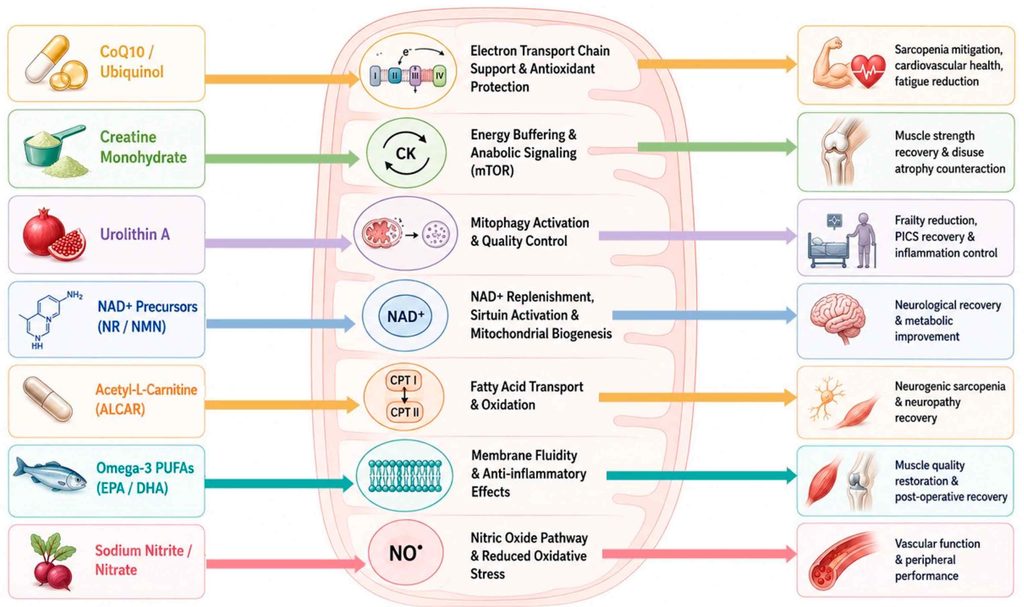
Restorin
Another possibility is taking Restorin, a multi-component nutraceutical that targets mitochondrial dysfunction, oxidative stress, and more. Studies have shown that nearly all age-related conditions, including frailty and sarcopenia, share similar underlying cellular defects, including mitochondrial dysfunction, oxidative stress, DNA damage, and inflammation. Restorin is designed to target the critical cellular defects that underlie age-related conditions. Nevertheless, Restorin has yet to be tested against aging and age-related diseases in humans.
 Comments