


Key Points:
- Supplementing with ginseng leads to higher NAD+ levels.
- Ginseng supplementation leads to longer telomeres.
- Ginseng also leads to a reduction in other aging biomarkers like lactic acid buildup.
The roots of Panax ginseng, a plant native to East Asia, have been used for thousands of years to enhance health and longevity. Modern science now supports ginseng’s capacity to target the underlying cellular processes that drive aging, and further empirical research may support the lore surrounding ginseng’s anti-aging properties. With this in mind, researchers from Changchun University of Chinese Medicine in China tested the effects of ginseng supplementation on several biomarkers of aging in middle-aged adults.
Ginseng Raises NAD+ Levels
To determine the effects of ginseng on aging, the Changchun University researchers carefully chose participants from a pool of 410 individuals. Only 30 were chosen, as the rest were excluded for various reasons, including 52 individuals who lied about their age. Only people with a BMI (body mass index) above 24 kg/m2, between the ages of 45 and 50, were included. These participants were chosen because being overweight and middle-aged are associated with accelerated aging.
The carefully chosen participants were given 3 grams/day of ginseng for 28 days. Throughout this duration, blood samples were taken to measure various aging biomarkers, including the NAD+/NADH ratio. NAD+ is an electron carrier, and it carries electrons in the form of NADH. While the NAD+/NADH ratio can indicate either elevated NAD+ or decreased NADH, NAD+ has repeatedly been shown to decline with age. Therefore, it is more likely that an increase in the NAD+/NADH ratio reflects an increase in NAD+.
The results showed that the NAD+/NADH ratio significantly increased after 14 days of ginseng supplementation. Moreover, the NAD+/NADH ratio increased until day 28 when supplementation was ended. After the supplementation period ended, the researchers waited another 28 days to measure NAD+/NADH one last time. By this time, the NAD+/NADH ratio had dropped to the point where it was no longer significantly elevated. These findings suggest that 3 grams/day of ginseng can potentially raise NAD+ levels.
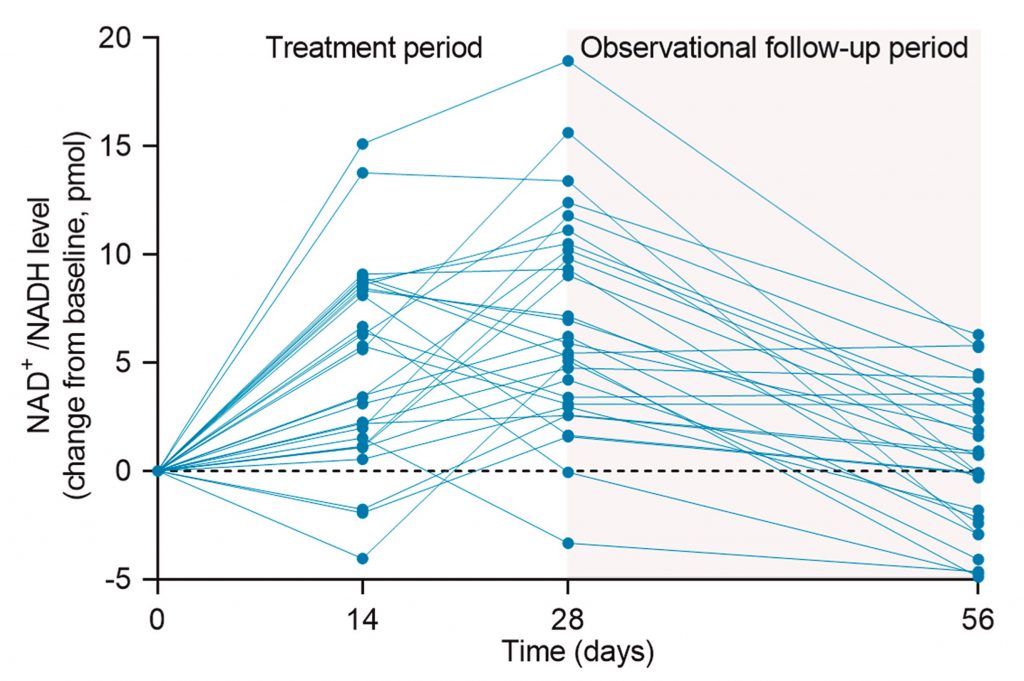
In addition to the NAD+/NADH ratio, the researchers measured the activity of an enzyme called NAMPT (nicotinamide phosphoribosyltransferase). NAMPT converts the NAD+ precursor NMN (nicotinamide mononucleotide) into NAD+. It is a rate-limiting enzyme, meaning that less NAMPT activity will inevitably lead to lower NAD+ levels. The results showed that NAMPT activity was significantly elevated on days 14 and 28 of ginseng supplementation. Moreover, NAMPT activity remained significantly elevated 28 days following the end of supplementation, the implications of which will require further study.
Ginseng Lengthens Telomeres
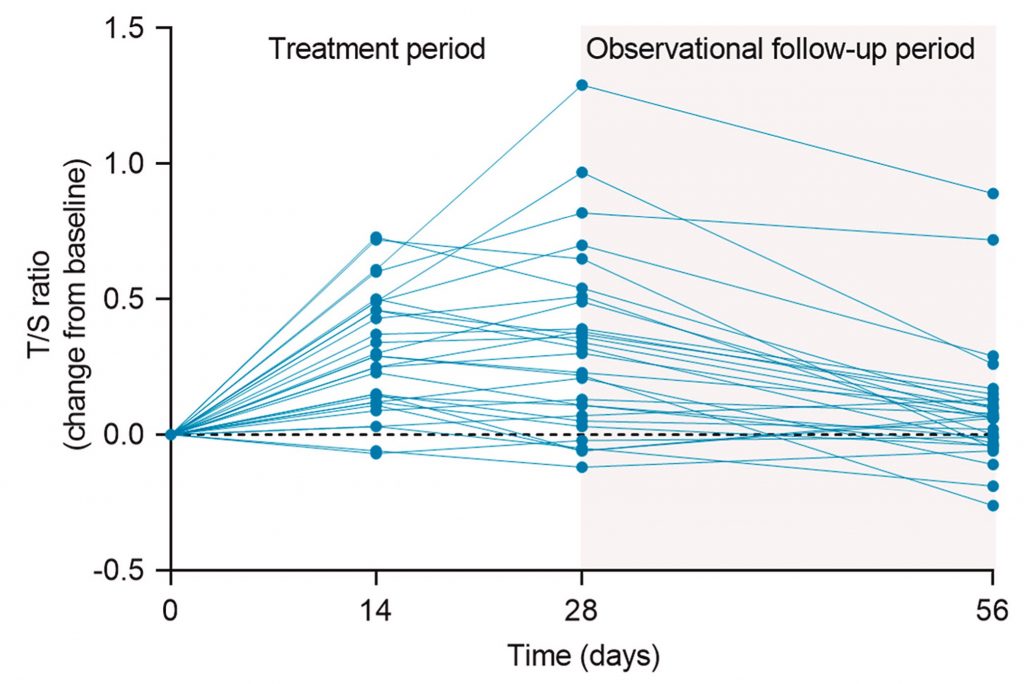
Telomeres are repetitive sequences of DNA at the ends of chromosomes that protect against DNA damage and cellular dysfunction. The shortening of telomeres has long been associated with the progression of aging, particularly of aging cells. The Changchun University researchers found that telomere length was significantly elevated after 14 and 28 days of ginseng supplementation. Similar to the NAD+/NADH ratio, this elevation subsided 28 days following the cessation of supplementation.
Notably, the researchers measured an important marker for telomere protection called POT1. POT1 is one of six proteins that make up the shelterin complex, which caps telomeres to prevent DNA damage. The researchers found that POT1 mRNA levels were elevated on days 14 and 28 of ginseng supplementation, persisting for at least 28 days after the supplementation period ended. These findings suggest that ginseng supplementation may prevent telomere shortening, but the cause of telomere elongation will require further study.
Ginseng Counteracts Other Signs of Aging
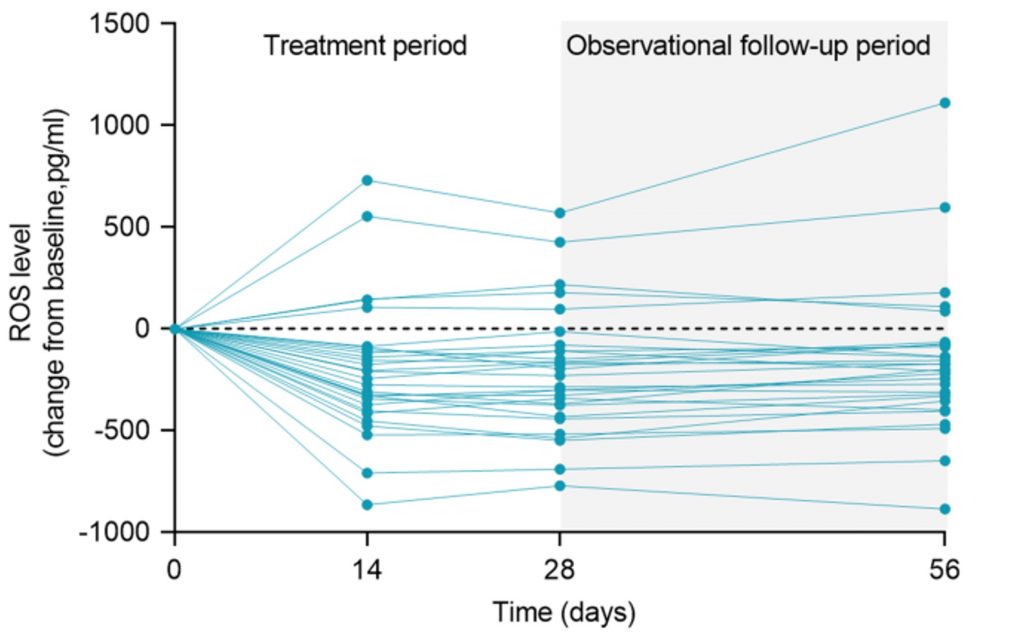
The Changchun University researchers measured additional biomarkers of aging, including reactive oxygen species (ROS) and oxidative stress. ROS are primarily produced by mitochondria during cellular energy production and, at normal concentrations, are harmless signaling molecules. However, with age, mitochondria become less efficient and begin to produce excess levels of ROS, which react with cellular components, like DNA, proteins, and fats. When ROS react with these components, it causes damage known as oxidative stress.
The researchers also measured AGEs (advanced glycation end-products) and lactic acid. AGEs form when sugars react with proteins in the body, accumulating with age and leading to increased inflammation and oxidative stress. Lactic acid buildup is another consequence of aging and mitochondrial inefficiency, which also increases inflammation and oxidative stress. Remarkably, the researchers found that ROS levels, oxidative stress, AGEs, and lactic acid levels were significantly reduced after 14 and 28 days of ginseng supplementation, which persisted 28 days after supplementation stopped.
Furthermore, using subjective assessment scales, the researchers examined the participants’ sleep, cognition, fatigue, erectile dysfunction, and menopausal symptoms. Lower scores on the Pittsburgh Sleep Quality Index (PSQI), Ascertain Dementia 8 (AD8), Fatigue Scale-14 (FS-14), International Index of Erectile Function-5 (IIEF-5), and the Kupperman index questionnaires indicated subjective improvements in sleep, cognition, fatigue, erectile dysfunction, and menopausal symptoms following 28 days of ginseng supplementation. However, only the sleep and cognition scores remained significantly low 28 days after ceasing supplementation.
The above results were assessed after long-term (28 days) supplementation with low-dose (3 grams) ginseng. In a separate group of participants, the researchers also examined the effects of short-term (7 days) supplementation with high-dose (6 grams) ginseng. This regimen resulted in telomere elongation and an elevated NAD+/NADH ratio after 7 days of supplementation, which persisted for at least 3 weeks following the end of the treatment period. However, the short-duration, high-dose regimen did not lower ROS levels, oxidative stress, AGEs, or lactic acid levels.
Ginseng’s Potential to Live Up to the Lore
This preliminary study opens the door for larger studies that include a placebo group. So far, ginseng appears to target several biological drivers of aging, including oxidative stress, shortened telomeres, and low NAD+ levels. However, more studies will be needed to determine whether this promotes health and longevity by reducing the occurrence of chronic age-related diseases. With that said, emerging evidence suggests that ginseng improves cognition in individuals with subjective cognitive impairments, mild cognitive impairment, and Alzheimer’s disease.
 Comments