


Key Points:
- Fasting for 16 hours a day increases the lifespan of male mice by 12%.
- Fasting increases the duration of time lived in good health in all mice.
- Intermittent fasting reduces fat and increases lean mass in all mice.
Many of us will spend our final years in poor health. To resolve this issue, scientists have worked feverishly on extending healthspan—the number of years lived in good health. Scientists have also been working on extending lifespan (the number of years lived), which would ideally coincide with an increase in healthspan.
In pursuit of extending healthspan and lifespan, researchers from the University of Texas Southwestern Medical Center have made a clarifying discovery. As published in Nature Aging, they show that 16-hour per day fasting extends the healthspan and lifespan of mice. These findings suggest the possibility of extending human healthspan and lifespan with fasting.
16-Hour-A-Day Fasting Improves Longevity
Time-restricted eating (TRE) involves consuming food only within a given window of time, such as from 8:00 am to 4:00 pm (16 hours of fasting). Time-restricted feeding (TRF) is the mouse equivalent of TRE, where mice are fed only within a given window of time.
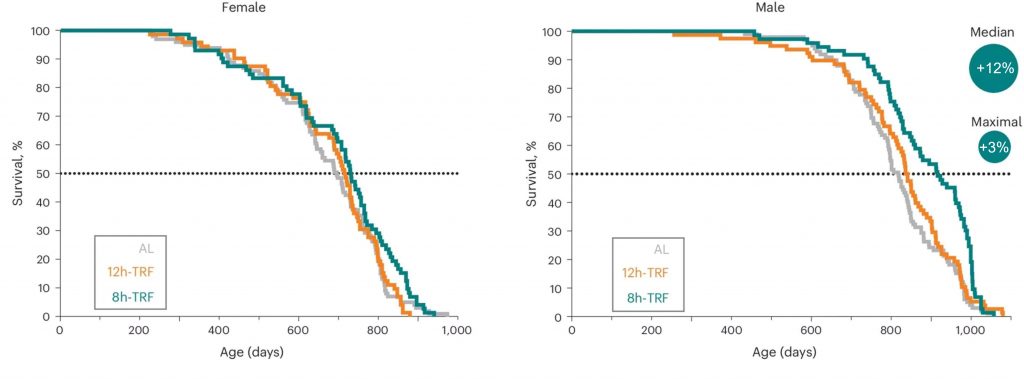
To implement TRF, the Texas researchers gave mice access to food for 8 hours (16 hours of fasting) or 12 hours (12 hours of fasting) a day. The mice on the TRF protocol were then compared to mice with 24/7 access to food. Remarkably, 16 hours of fasting extended the median (when 50% of mice were alive and 50% dead) and maximum (when all mice were dead) lifespan of male mice. However, TRF did not extend the lifespan of female mice, and 12 hours of fasting did not extend the lifespan of male or female mice.
16-Hour-A-Day Fasting Improves Healthspan
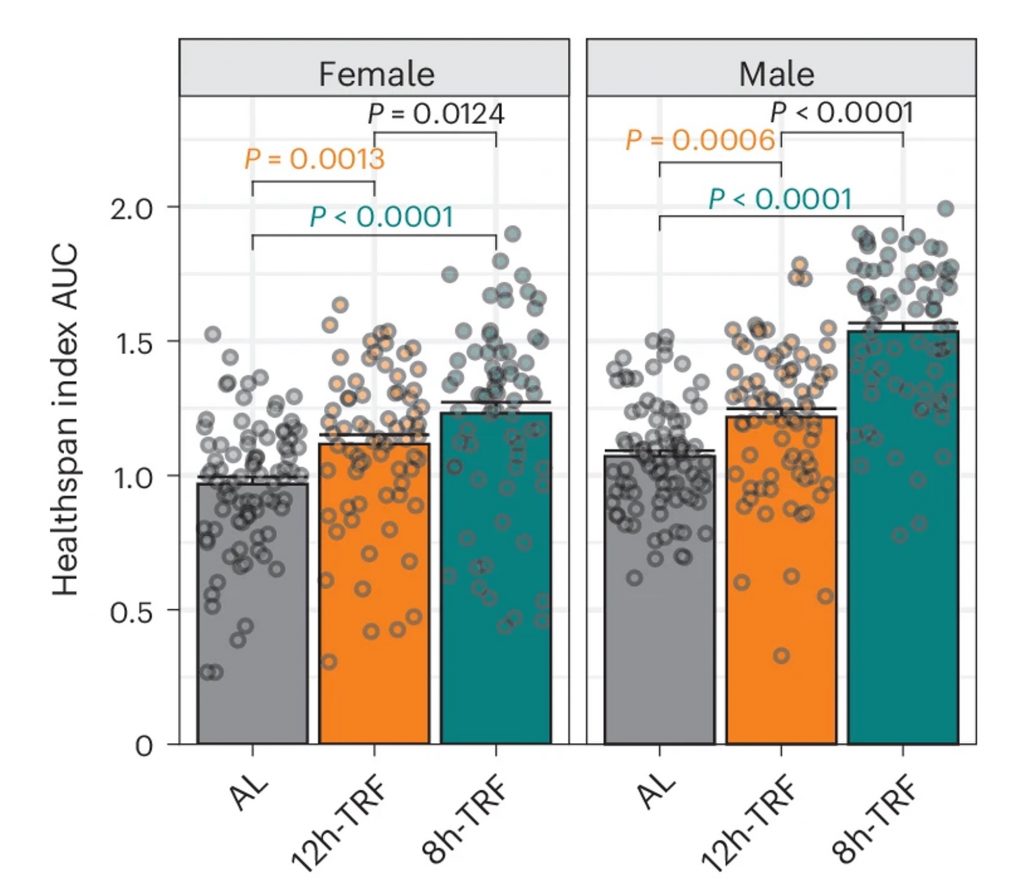
To determine if TRF improves healthspan, the researchers came up with their own scoring system. The scoring system included a condition known as frailty, which is a state of increased susceptibility to disability, disease, and death. Frailty was measured with 31 health parameters, including gait, strength, hearing, and vision. However, frailty measurements do not incorporate important aging parameters, such as changes in behavior and food consumption.
Therefore, to assess healthspan, the Texas researchers integrated frailty with 12 more health parameters. These additional parameters included wheel running activity, food consumption, and body composition. In the case of body composition, TRF tended to reduce fat and increase muscle. Overall, using their healthspan scoring system, the researchers found that TRF increased healthspan in all mice. Moreover, the increase in healthspan was linked to the increase in lifespan.
16-Hour-A-Day Fasting Improves Body Weight During Middle Age
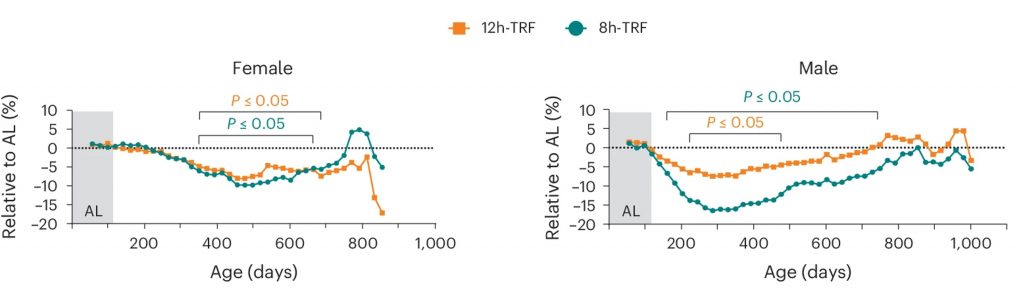
The University of Texas Southwestern Medical Center researchers measured the mice’s body weight across their lifespan. They found that TRF reduced body weight, particularly during the middle stage of life. This was largely due to reduced body fat and increased lean mass, which includes muscle mass. Nevertheless, the researchers did not find changes in inflammation or glucose levels, suggesting that these factors contributed little to the observed health- and lifespan extension.
These findings suggest that maintaining a healthy weight and body composition promotes health and longevity more than hormonal or inflammatory changes. With that being said, the researchers also found that TRF improved the mice’s daily rhythms in feeding and physical activity, suggesting improvements in circadian rhythms. Since optimal circadian rhythms support health and longevity, the researchers concluded that stricter daily rhythms contributed largely to TRF’s effect on health- and lifespan.
Eating Less to Live Longer
Caloric restriction (CR)—consuming fewer calories—remains the most robust longevity intervention tested by scientists. The Texas researchers found that the group of mice that saw an increase in lifespan (male mice on the 8-hour TRF protocol) self-imposed CR on themselves. For most of their lifespan, they consumed about 20% fewer calories than normal. These findings suggest that the beneficial effects of TRF on longevity may be due to CR. However, the female mice on the 8-hour TRF protocol also consumed about 20% less calories, suggesting that females need to eat even less than males to achieve lifespan extension.
Studies have already shown that TRE improves the health of humans. In one study, elderly, overweight men fasted for 16 hours a day and, after 6-weeks, they exhibited a decrease in body weight, fat mass, and waist circumference, but no increase in muscle mass. These findings suggest that TRE reduces fat, which can have metabolic benefits that promote health and longevity.
Moreover, an analysis of 19 human studies showed that TRE reduces fat mass, blood pressure, and blood glucose levels, and increases lean mass in people who are overweight or obese. Notably, the benefits of TRE were only seen with CR. These studies suggest that TRE may improve our health- and lifespan primarily by reducing the amount of food we consume per day. This means that eating less, whether it be with an eating window or not, may help us live longer.
 Comments