


Key Points:
- Northeastern University and Harvard University scientists have devised a new framework that links 2,358 genes to aging and longevity.
- Genes related to the hallmarks of aging formed connected networks, and drugs that changed the expression of genes in these networks were considered candidates to counteract aging.
- The scientists analyzed 6,442 existing compounds and identified 21 with pro-longevity potential, along with 23 that may accelerate aging.
Over the last 10 years or so, large-scale human genetic analyses and animal model experiments have implicated thousands of genes in physiological processes related to aging. Importantly, researchers have focused particularly on how these genes underpin biological processes involved in age-related functional decline—processes known as hallmarks of aging.
While researchers’ efforts on how certain genes relate to these hallmarks of aging have offered a remarkable opportunity to dissect molecular mechanisms of longevity, we still mostly lack interventions that significantly modulate specific processes of aging. This shortfall may come from the multitude of genes and pathways involved in aging, which could limit the impact of any single intervention.
Now, as published in Nature Aging, to address this shortfall, scientists from Northeastern University and Harvard University in Boston have introduced a framework based on gene networks underlying the hallmarks of aging. The framework integrated data on thousands of aging-associated genes, along with their relationships to the hallmarks of aging. Strikingly, specific hallmark-associated genes aggregated into gene networks, forming network hubs associated with specific hallmarks.
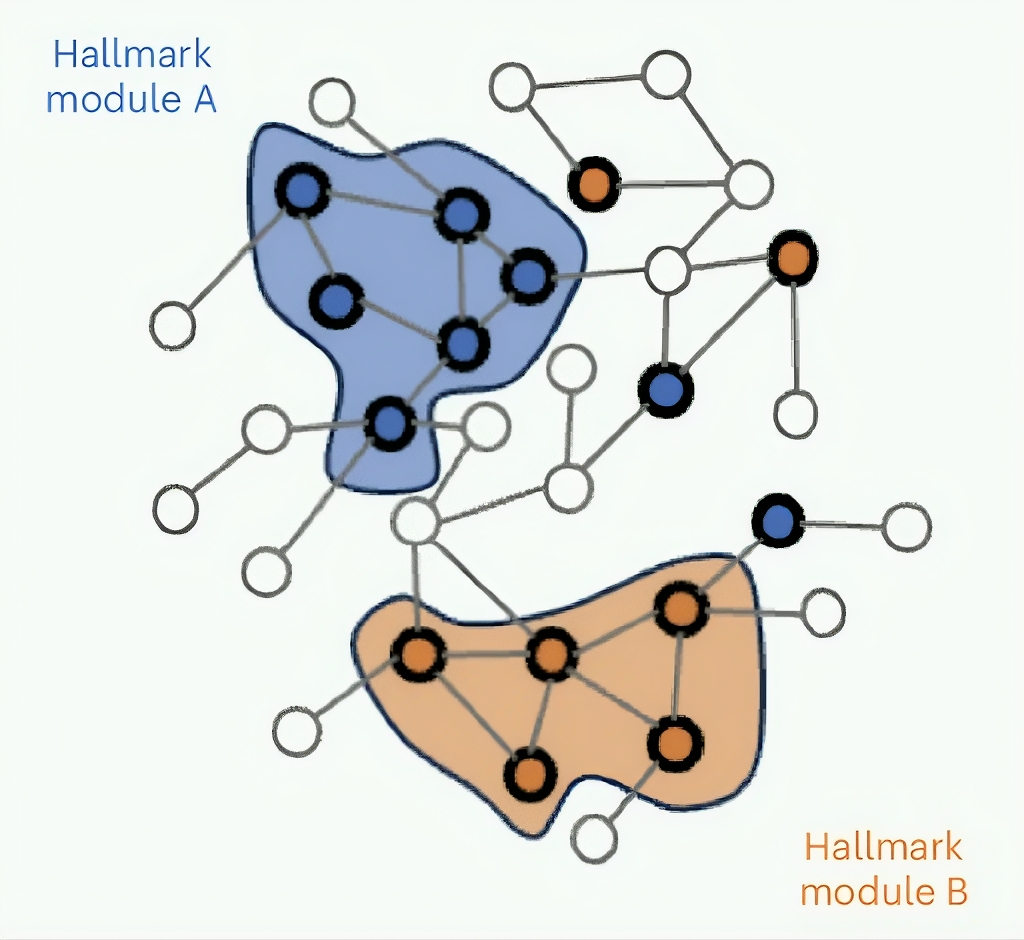
The framework also entailed the development of a metric that allowed the assessment of drugs’ effects on the activity (expression) of aging-associated genes. The authors reasoned that increasing age-related gene expression may speed up aging, while changing it in the opposite direction may promote longevity. This allowed the evaluation of pro-longevity or age-accelerating effects. Collectively, the framework allowed the identification of already-approved drugs that perturb aging-associated gene expression, some of which may slow aging and others that may accelerate aging.
Background on the Conundrum Surrounding the Development of Drugs Against Aging
Scientists who study aging typically describe the multi-faceted nature of aging with the hallmarks of aging, which denote distinct age-related mechanisms, from chronic inflammation to dysfunction of the cell’s powerhouses (mitochondria). Although each of the hallmarks is intended to describe a distinct biological process, they are not fully distinct. As such, extensive cross-talk exists among them. For example, inflammation can also lead to mitochondrial dysfunction.
All the while, current therapeutic intervention strategies typically target one or a few of these hallmarks. However, a comprehensive strategy to counter the effects of aging will likely require interventions that target multiple hallmarks of aging, given their cross-talk and interconnectedness. Even so, developing aging intervention compounds is time-consuming and costly and would require at least a decade to reach clinical application.
As an attractive alternative, repurposing drugs from the pool of over 6,000 clinically approved or experimental compounds could yield agents that target specific hallmarks of aging. The identification of potential aging intervention drugs from this pool would speed up the application of the interventions and lower the cost of development, since they are already available. Moreover, there is also the possibility of combining them to target multiple hallmarks of aging simultaneously, which would need to be tested to verify any additive or synergistic effects they may have, as well as safety.
A Framework Predicting Repurposable Drugs with Pro-Longevity or Age-Accelerating Effects Based on Statistical Networks
To begin the development of their framework for the identification of potentially repurposable drugs against aging, the Boston-based researchers utilized a database of 2,358 genes linked to longevity. From these genes, the researchers identified 1,250 that are explicitly associated with hallmarks of aging. Of these genes, 860 are linked to a single hallmark of aging, while 390 span multiple hallmarks. Thus, the 390 genes associated with multiple hallmarks of aging support the notion that, at the molecular level, the hallmarks of aging are not independent biological processes but are interconnected.
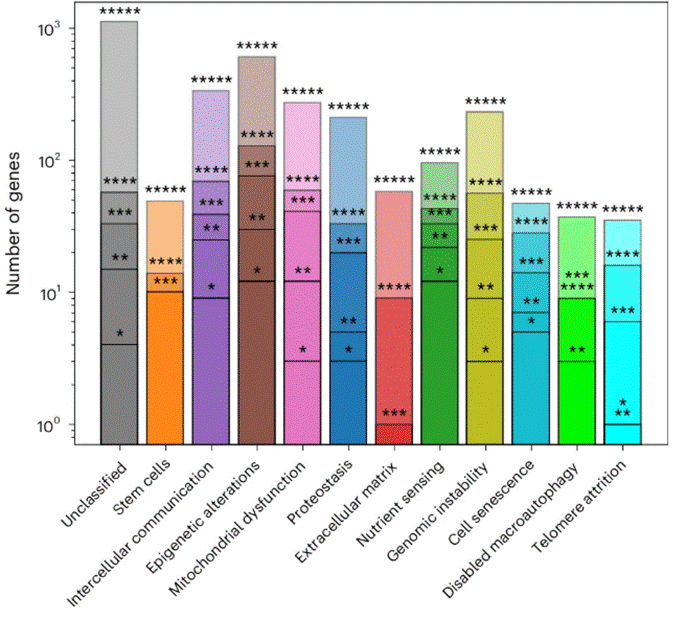
To unravel the gene network organization of aging, the scientists mapped the 1,250 hallmark-associated genes onto a chart they called the human interactome—a comprehensive catalog of binding events between proteins encoded by the 1,250 genes. The research team ran statistical analyses and found that, for nine out of 11 hallmarks they examined, genes were associated in statistical network clusters. In other words, the hallmark-associated genes aggregate in network neighborhoods, each representing a hallmark module within the human interactome. This finding establishes that genes for hallmarks of aging form well-defined and statistically significant network modules, supporting the notion that the hallmarks of aging are biological processes underpinning aging.
To then examine whether the hallmark modules overlap, the researchers assessed the proximity of the modules in statistical networks. In networks, a closer proximity is an indicator of connectivity between the functions of genes within these modules. Indeed, they found that the hallmark modules were located in the same network neighborhoods and formed a broader longevity module. This finding supports the existence of shared molecular mechanisms underlying the hallmarks of aging in relation to longevity.
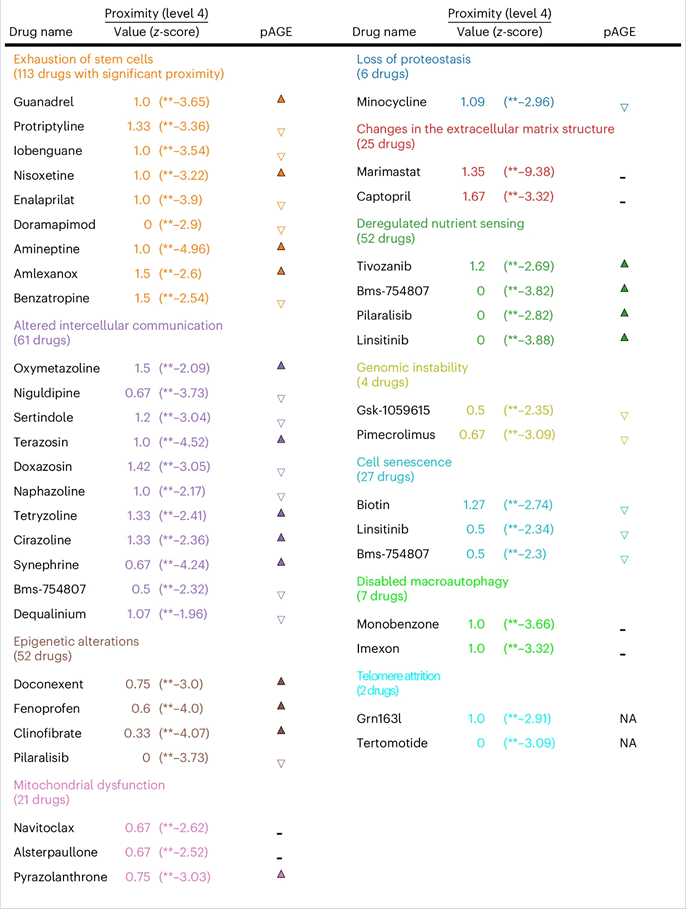
The existence of the hallmark modules presented the opportunity to apply a network-based drug repurposing method. To this end, the scientists compiled a list of 6,442 approved or clinically tested drugs. Their approach for analyzing the potential effects of these drugs against aging rested on the premise that drugs that alter the expression of genes in the proximity of a given hallmark module perturb that hallmark. Thus, they developed a framework to measure the proximity of genes with expression altered by the drugs to each hallmark module.
In addition to identifying drugs predicted to perturb the hallmark modules, the researchers sought to predict whether the perturbation would be beneficial or detrimental to aging. Because changes in age-related gene expression occur with age, they introduced a metric that quantifies whether drug-induced changes in gene expression accelerate or counter age-related shifts in gene expression based on expression changes. In other words, if a drug increases the expression of a gene known to increase in expression with age, one could anticipate an adverse effect on aging. Conversely, reducing the expression of the same gene may be advantageous.
Once the researchers established this framework, the team identified 21 potentially repurposable drugs predicted to have pro-longevity effects, as well as 23 predicted to accelerate aging. Moreover, the researchers identified 16 drugs with inconsistent predictions, meaning that they could not predict what effects these drugs may have on longevity. These results reveal the candidate drugs predicted to counteract or accelerate aging.
To gauge the accuracy of their framework, the researchers tested whether it predicted pro-longevity effects of drugs found to extend mouse lifespan and others under clinical investigation for pro-longevity effects in humans. They found that, for the mouse lifespan-extending compounds, the framework predicted pro-longevity effects with 100% accuracy. For the compounds undergoing clinical testing, the framework predicted pro-longevity effects with 88.9% accuracy. These results suggest that the framework may confer some degree of accuracy in predicting pro-longevity benefits for certain repurposable drugs.
“Ultimately, our findings underscore the potential of leveraging the extensive hallmark-associated genetic evidence to identify drug-repurposing candidates for healthy longevity,” say the scientists in their publication.
Determining Whether Combining Compounds to Target Multiple Hallmarks Has Additive or Synergistic Effects Against Aging
The framework that the Boston-based scientists employed highlights the potential pro-longevity effects of already-approved drugs and the possible age-accelerating effects of others. Testing whether these drugs significantly affect human lifespan would be infeasible, since human lifespan studies would take decades due to the long duration of the human lifespan, compared to other species like mice. Moreover, human lifespan studies would require a non-treated group for comparison, and many people may not want to participate in a lifespan study and not receive a potential aging intervention in a non-treated group.
To get around the complications of human lifespan studies, researchers could instead employ epigenetic age tests that could provide some support for pro-longevity effects. These tests use blood or saliva samples to measure how fast the body is aging by measuring molecular tagging patterns on DNA. As such, if taking a drug predicted to have pro-longevity effects slows the pace of aging, as measured with this kind of test, over the course of months or a few years, this would support that the drug indeed confers pro-longevity effects.
Additionally, using epigenetic age tests could help unravel whether combining drugs predicted to confer pro-longevity effects have additive or synergistic pro-longevity effects. If combining drugs predicted to perturb different hallmarks of aging with pro-longevity effects conferred better effects on epigenetic age tests than any drug on its own, this would support that targeting multiple hallmarks of aging simultaneously works against aging better than targeting one.
Relatedly, SRN-901, a drug that the nutraceutical Restorin is roughly based on, targets multiple hallmarks of aging and was shown to increase remaining lifespan by 33% in aged mice. The hallmarks of aging targeted by SRN-901 include the buildup of dysfunctional cells that can emit inflammatory molecules (senescent cells), mitochondrial dysfunction, and inflammation, among others.
The substantial mouse lifespan extension with SRN-901 supports the notion that targeting multiple hallmarks of aging confers additive or synergistic pro-longevity effects. Accordingly, using more than one repurposable drug predicted in the framework to have pro-longevity benefits could target more than one hallmark of aging and possibly extend lifespan.
 Comments