


Key Points:
- A newly developed measurement system shows that blood NAD+ levels do not decline with age and that blood NAD+ is elevated in obese individuals.
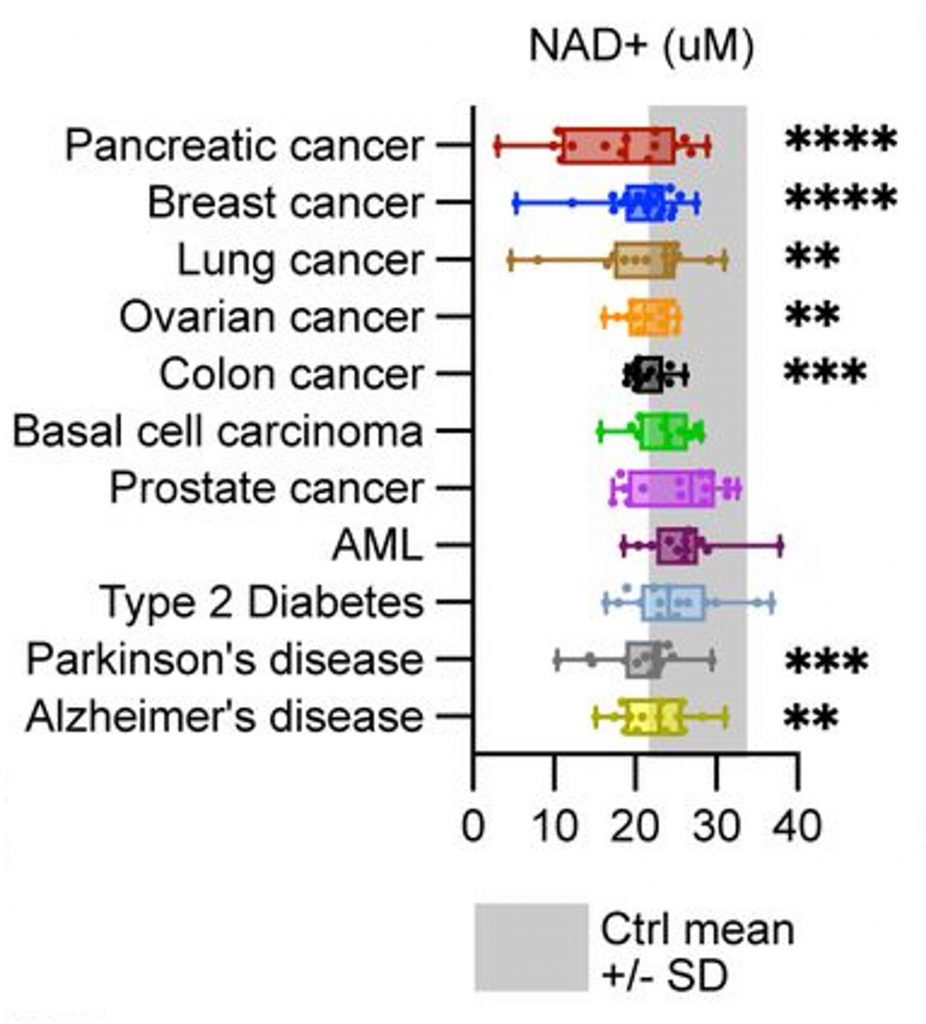
- The new system shows that NAD+ levels are low in several cancers, Alzheimer’s disease, and Parkinson’s disease.
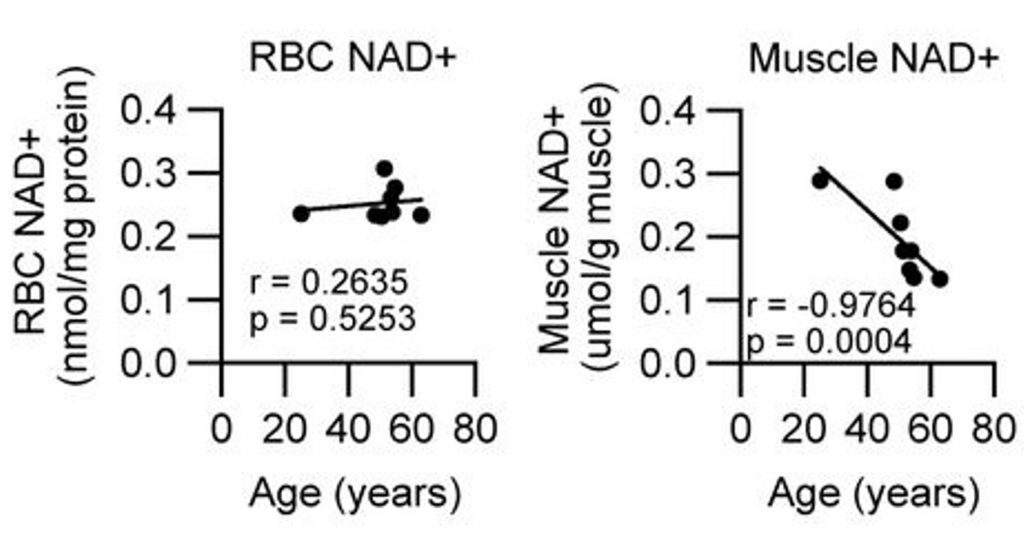
- In a smaller set of participants, NAD+ levels are shown to decline with age in muscle.
- In the same smaller set, the B vitamin niacin was shown to boost blood NAD+ levels four to six-fold.
A long-held narrative in longevity research is that NAD+ levels naturally decline with age. But a new preprint study from researchers at the University of Helsinki suggests this may not be the case. They also show that NAD+ levels are low in patients with cancer and neurodegenerative disorders. Moreover, the NAD+ booster niacin was found to elevate blood NAD+ levels in healthy individuals. These findings could help identify who may benefit most from NAD+ treatment.
A New Way of Measuring NAD+
We are, in a sense, electrical beings, since many essential processes in the body depend on the movement of electrons. Fundamentally, the movement of electrons, negatively charged subatomic particles, is what produces electricity. In our cells, electrons move from molecule to molecule in what are known as redox (reduction-oxidation) reactions. NAD+ accepts electrons from other molecules, making it a redox metabolite.
Redox metabolites like NAD+ are highly unstable and degrade easily when taken out of the body. This can make measuring NAD+ levels from blood samples inaccurate if not handled carefully. However, NAD+ and other redox metabolites are closely linked, and changes in one can reflect changes in others. With this in mind, the Finnish researchers developed a measurement system that evaluates NAD+ and the other major redox metabolites simultaneously.
The Other Redox Metabolites
In addition to NAD+, the researchers measured NADP+, NADPH, NADH, glutathione (GSH), and glutathione disulfide (GSSG). NADP+ carries electrons and becomes NADPH, just as NAD+ becomes NADH when it carries electrons. GSH neutralizes free radicals by transferring electrons and becomes GSSG. Notably, NADH and NADPH can also neutralize free radicals. The neutralization of free radicals reduces cellular damage and promotes health and longevity. Crucially, cellular health depends on the balance of these redox pairs (NAD+/NADH, NADP+/NADPH, and GSH/GSSG).
NAD+ Levels in Aging and Obesity
After establishing their measurement system, the Finnish researchers measured NAD+ levels from the blood samples of 18- to 70-year-old donors. Contrary to previous studies, they found that NAD+ levels did not decline with age in these 237 healthy individuals. Also, contrary to previous studies, the researchers showed that NAD+ levels were higher in obese individuals than in normal-weight individuals. Previous studies suggest that blood NAD+ levels decline with age and in obese individuals, but these new results call earlier findings into question. Still, the researchers confirmed that NAD+ levels are generally lower in females than in males.
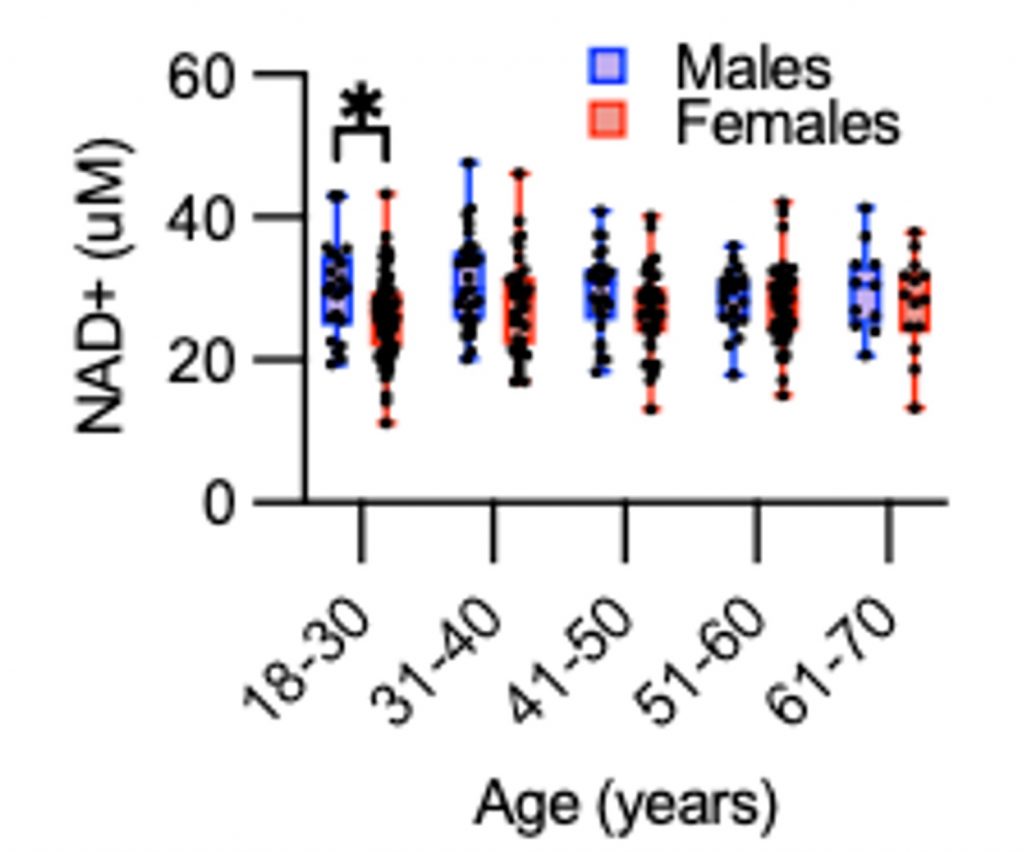
NAD+ Levels in Age-Related Diseases
To determine if alterations in redox metabolites are associated with chronic age-related diseases, the researchers examined 11 different conditions. They found that NAD+ levels were particularly low in pancreatic and breast cancer, while moderately low levels were detected in lung, ovarian, and colon cancer. NAD+ levels were also low in the neurodegenerative disorders, Parkinson’s and Alzheimer’s disease, in line with previous studies. However, contrary to previous studies, NAD+ levels were not low in type 2 diabetes. Still, at least one of the six redox metabolites was significantly off balance in all 11 conditions.
Niacin Boosts NAD+, Which Declines with Age in Muscle
Because NAD+ itself is unstable, if orally administered, it breaks down during digestion and is not efficiently absorbed into the bloodstream. In other words, NAD+ has low bioavailability, which is why some choose to administer it via intravenous (IV) injection. Nevertheless, many studies have shown that blood NAD+ levels can be boosted with molecules called NAD+ precursors.
One of the most common NAD+ precursors is niacin. The Finnish researchers previously showed that niacin restores blood and muscle NAD+ levels in people with muscle mitochondrial disease. For these reasons, the Finnish researchers examined the effects of niacin supplementation on eight healthy individuals. They found that 1000 mg of niacin increased blood NAD+ levels four to six-fold. In this set of participants, NAD+ levels also did not decline with age. However, NAD+ levels declined with age in muscle tissue. The researchers did not report the effects of niacin on muscle NAD+ levels for unknown reasons.
Do NAD+ Levels Decline with Age or Not?
Human studies on blood NAD+ and aging have produced mixed results, with some showing a decline and others finding no clear age-related change. This would make it unfair to say that NAD+ levels naturally decline with age, at least within the cells of the bloodstream. Interestingly, the Finnish population may be among the most physically active in the world. What’s more, studies suggest that NAD+ levels can be maintained with regular exercise. Based on these observations, it’s possible that NAD+ levels decline with age in sedentary individuals but not in physically active individuals.
Additionally, the Finnish researchers found that muscle NAD+ levels decline with age in a small cohort of healthy individuals. Moreover, other studies suggest that NAD+ levels decline with age in the fat tissue of obese individuals and in the brain of healthy individuals. Arguably, age-related NAD+ decline in fat, the brain, muscle, and other organs and tissues may be more deleterious to longevity than low blood NAD+ levels.
To make this clearer, a future study could examine age-related NAD+ levels in multiple tissues (e.g., blood, fat, muscle, brain) in healthy participants and participants suffering from age-related chronic conditions (e.g., obesity, sarcopenia, dementia). Also, considering that diet also affects NAD+ levels, each participant’s diet and physical activity levels could be accurately assessed. However, doing this with a large pool of participants will be costly, time-consuming, and likely necessitate collaboration between multiple research groups.
 Comments