


Key Points:
- Compared to skin tissue from young people, skin cells from older people have lower levels of nicotinamide.
- In mice, nicotinamide prevents skin damage caused by ultraviolet radiation, which accelerates skin aging.
- Nicotinamide may counteract skin aging by reducing the accumulation of senescent cells.
Wrinkly skin is possibly the most obvious outward manifestation of aging. It’s caused by the breakdown of proteins like collagen, which maintain the structural integrity of skin.
In the pursuit of understanding aging, scientists have proposed a set of hallmarks that underlie the aging process. These hallmarks, such as senescent cells and inflammation, contribute to the breakdown of tissues like the skin. The hope is that targeting these hallmarks can delay the aging process, and researchers are currently investigating compounds that may do so.
One such compound is nicotinamide. As an NAD+ precursor, nicotinamide is converted into NAD+ within the body. In turn, NAD+ may target several hallmarks of aging to delay the breakdown of tissues like the skin. In a recent study, published in Current Issues in Molecular Biology, scientists from Yunnan University in China provide evidence to support this notion.
Altered NAD+ Synthesis in Aged Skin
To examine genes related to NAD+ synthesis, the Yunnan University researchers compared the skin tissue of normal mice to that of mice chronically exposed to ultraviolet (UV) radiation. Studies suggest that UV exposure could account for up to 80% of visible skin aging, including wrinkles. The researchers found that genes involved in NAD+ synthesis were reduced in mouse skin chronically exposed to UV light. The researchers also found that nicotinamide was lower in the skin tissue of older individuals compared to younger individuals.
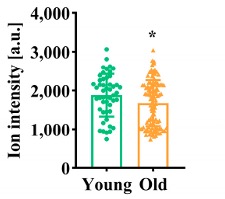
Nicotinamide Contributes to Preventing Skin Aging in Mice
As skin nicotinamide levels appear to be diminished in older individuals, the researchers sought to determine whether replenishing nicotinamide could prevent skin aging. To do so, they exposed the skin of mice to UV radiation and then topically applied nicotinamide in varying doses. They found that nicotinamide treatment visibly improved the condition of the skin. The improvements included fewer wrinkles, less reddening, and reduced flaking. The treatment also countered skin thinning and reduced pro-inflammatory immune cells within the tissue.
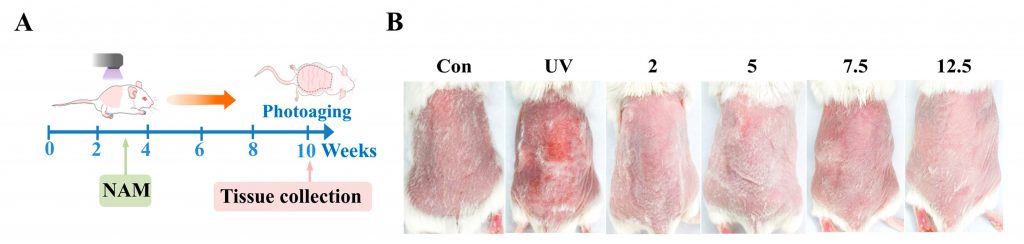
To test whether nicotinamide improves the structural integrity of skin, the researchers measured three structural proteins, including collagen. They found that higher concentrations of nicotinamide (5%, 7.5%, and 12.5%) increased two proteins, ZO-1 and E-cadherin. Interestingly, collagen was only elevated by 5% and 7.5% nicotinamide, but not 2% or 12.5% nicotinamide. These findings suggest that a certain concentration of topical nicotinamide elevates proteins involved in the structural integrity of skin.
Nicotinamide Counteracts Cellular Senescence
Senescent cells, a hallmark of aging, are cells that accumulate with age and can support chronic inflammation and tissue breakdown. Most of our cells can become senescent cells in response to environmental stressors like UV radiation or bodily stressors like inflammation. Once a cell enters a senescent state, it can no longer divide, which is thought to protect against the progression of cancer. Usually, senescent cells are eliminated by the immune system, but with age, the immune system can become less effective, allowing senescent cells to accumulate.
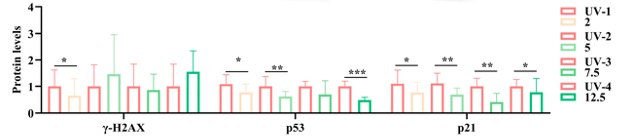
The Yunnan University researchers measured three proteins associated with senescent cells, including γ-H2AX, which is involved in DNA repair. They also measured proteins called p53 and p21, which are involved in stopping cells from dividing. They found that all concentrations of nicotinamide reduced p21 in UV-exposed mice. Strangely, only 2% nicotinamide reduced γ-H2AX, and only 7.5% nicotinamide did not reduce p53. These findings suggest that nicotinamide can reduce markers of senescent skin cells, but the dose needs to be worked out.
Senescent cells contribute to tissue breakdown by secreting pro-inflammatory and tissue-degrading proteins. The researchers measured two of the tissue-degrading proteins, MMP1 and MMP12. They found that 2% nicotinamide reduced MMP12 in UV-exposed mice. Strangely, only 5% nicotinamide did not reduce MMP1. These findings point to nicotinamide as an intervention against tissue-degrading proteins, but it is likely that more studies with more consistent results are needed to determine the proper dose.
Taking Nicotinamide to Counteract Skin Aging
Several studies have shown that topical nicotinamide, usually called niacinamide in skin products, counteracts skin aging. In one such study, 6% nicotinamide was combined with hyaluronic acid, a molecule that naturally occurs in the skin. The nicotinamide/ hyaluronic acid combo was shown to counter skin aging and reduce signs of cellular senescence. This means that topical nicotinamide may reduce senescent skin cells, or at least the harmful molecules they secrete, in humans.
We have previously reported on a study showing that senescent cells spread signs of aging, such as skin thinning, across the skin of mice. The previous study also showed that senescent skin cells trigger aspects of aging in muscle and bone tissues. Remarkably, senescent skin cells also spread senescence to the brain, causing memory loss. While senescent cells can induce senescence in surrounding cells through direct cell-to-cell contact, they also secrete molecules that can induce senescence in distant cells.
Since senescent skin cells may induce senescence in other organs, eliminating them from the skin with nicotinamide may reduce body-wide senescent cell accumulation. Senescent cell accumulation is associated with many age-related diseases, including Alzheimer’s and heart disease. Thus, removing them may increase the chances of living a longer life. However, human studies are needed for confirmation. Still, topical nicotinamide, at doses near 5%, appears to counteract certain biological aspects of skin aging.
 Comments