


Key Points:
- Dasatinib and quercetin reduced intervertebral disc degeneration in mice prone to accelerated spinal aging.
- Treatment lowered the burden of senescent cells and inflammatory signaling within spinal discs.
- Treated mice retained healthier disc structure and showed less fibrosis, a form of scar-like tissue buildup.
According to the World Health Organization, musculoskeletal conditions affect approximately 1.71 billion people worldwide and are the leading contributor to disability globally. Low back pain alone affects an estimated 570 million people and remains the leading cause of disability in 160 countries. One of the most common underlying causes is intervertebral disc degeneration, a condition in which the discs that cushion the vertebrae gradually lose their structure and function. Notably, people with significant disc degeneration are approximately three times more likely to experience chronic low back pain, yet current treatments largely focus on symptom management rather than on repairing the underlying damage.
Researchers have increasingly linked disc degeneration to cellular senescence, a process in which damaged cells stop dividing but remain metabolically active. Rather than quietly disappearing, these cells release inflammatory molecules that can damage nearby tissue and accelerate aging. Senescent cells accumulate naturally with age, but they can also arise in response to stress, injury, or disease.
In a recent study published in Bone Research, researchers investigated whether removing senescent cells could slow the progression of disc degeneration. Using a mouse strain that develops spontaneous early-onset disc degeneration, the team tested a senolytic treatment consisting of dasatinib and quercetin, a combination commonly referred to as DQ. Senolytics are compounds designed to selectively eliminate senescent cells. The researchers found that DQ reduced degeneration, preserved healthy disc tissue, decreased inflammation, and improved several biological markers associated with spinal aging.
Senescent Cells Appeared Before Major Disc Damage
To understand whether cellular senescence contributes to disc degeneration, the researchers first examined spinal discs from SM/J mice, a strain that develops spontaneous degeneration at a relatively young age. They compared these animals with healthy control mice and measured several markers commonly associated with senescence.
Even before substantial structural damage was visible, SM/J mice showed elevated levels of p19 and p21, proteins that are widely used as indicators of cellular senescence. Gene expression analysis further revealed molecular signatures associated with aging, inflammation, and tissue degeneration. Many of these signatures overlapped with previously established senescence-related gene sets. These findings suggest that cellular senescence contributes to the development of disc degeneration.
Clearing Senescent Cells Reduces Disc Degeneration
To determine whether eliminating senescent cells could improve disc health, the researchers treated SM/J mice with weekly doses of dasatinib and quercetin beginning at four weeks of age and continuing through 17 weeks. Another group received a different senolytic drug, navitoclax, while control animals received vehicle treatment.
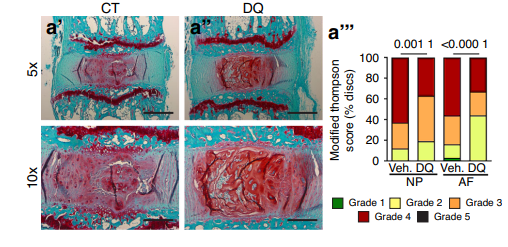
When the researchers examined the spinal discs at the end of the study, mice receiving DQ showed healthier disc structure, clearer separation between the different regions of the disc, and fewer structural abnormalities than untreated animals. Using a standardized scoring system to assess disc degeneration, the researchers found approximately 25% fewer severely degenerated discs in the DQ-treated group. In contrast, untreated mice showed more extensive tissue deterioration and loss of normal disc organization. Notably, a different senolytic drug, navitoclax, did not produce similar benefits.
Treatment Reduces Inflammation, Fibrosis, and Cell Loss
To understand why DQ improved disc health, the researchers measured markers of senescence, inflammation, and tissue remodeling within the discs. Treatment reduced levels of p19 and p21, indicating a lower burden of senescent cells. The researchers also observed reductions in several inflammatory molecules associated with the senescence-associated secretory phenotype, or SASP. Senescent cells often release these inflammatory signals, which can amplify tissue damage and accelerate degeneration.
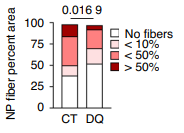
DQ also preserved healthy disc cells and reduced fibrosis. DQ-treated mice retained higher levels of markers associated with healthy nucleus pulposus cells, the specialized cells that occupy the soft center of the disc. The treatment also reduced fibrosis, a process in which normal tissue is gradually replaced by stiff, scar-like collagen deposits. Untreated mice accumulated substantial collagen within the disc as degeneration progressed, whereas DQ-treated animals maintained a healthier tissue composition.
Finally, treated mice showed lower rates of programmed cell death, suggesting that the therapy helped preserve viable disc cells. Together, these findings indicate that removing senescent cells not only reduces harmful inflammatory signaling but also helps maintain the structural and cellular features required for healthy disc function.
Targeting Cellular Aging Could Change How Disc Degeneration Is Treated
Degenerative disc disease remains one of the most difficult age-related conditions to treat because current therapies largely address symptoms rather than the biological causes of degeneration. Scientists have increasingly turned to regenerative approaches, particularly stem cell therapies, in an effort to restore damaged spinal discs. Several clinical trials have reported improvements in pain and physical function following stem cell treatment, and multiple ongoing studies continue to evaluate whether stem cells can help regenerate disc tissue.
Yet stem-cell therapies have also faced challenges. Some trials have shown biological signs of repair without clear clinical improvements, highlighting the difficulty of regenerating tissue that already contains large numbers of dysfunctional senescent cells.
The findings suggest that removing senescent cells could help create a more favorable environment for tissue repair. By reducing inflammation, limiting fibrosis, and preserving healthy cellular function, senolytic therapies may enhance the effectiveness of regenerative approaches such as stem cell treatments.
Although the current study was conducted in mice, the results support a growing body of research linking cellular senescence to age-related tissue degeneration. Senolytic therapies target dysfunctional cells that promote inflammation, fibrosis, and tissue decline, addressing biological processes that contribute directly to disc degeneration. Because intervertebral discs have limited capacity for self-repair, damage often accumulates over time and can become increasingly difficult to reverse. As researchers continue developing interventions that target the mechanisms of aging, therapies such as dasatinib and quercetin could help slow the progression of degenerative disc disease and preserve spinal function with age.
 Comments