


Key Points:
- Daily rapamycin treatment extended marmoset lifespan by approximately 10–15% in a trial involving nearly 70 animals, according to unpublished findings discussed by Dr. Adam Salmon.
- Treated marmosets showed signs of preserved kidney function and delayed dental disease, suggesting benefits for some aspects of health as well as longevity.
- A higher risk of knee osteoarthritis in treated female marmosets underscores the need to investigate potential trade-offs.
A drug long studied for its potential to slow aging extended average lifespan in a small primate, offering an intriguing, but preliminary, clue about its effects beyond laboratory rodents. In a recent interview on YouTube, Dr. Adam Salmon from UT Health San Antonio in Texas described unpublished findings showing that marmosets treated with rapamycin lived approximately 10–15% longer than untreated animals. The reported results raise questions about whether the drug could also preserve human health with age, but potential side effects, such as dysregulated blood sugar, remain an important part of the picture.

More Information on Rapamycin
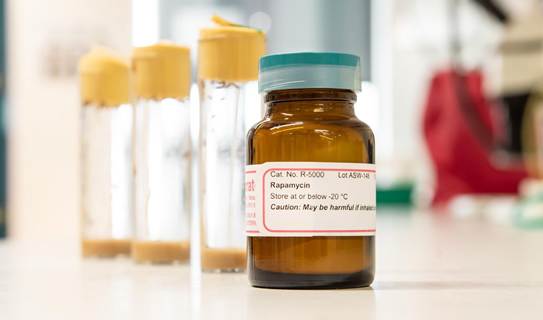
Rapamycin, also known as sirolimus, is a prescription drug originally developed from a compound produced by soil bacteria found on Rapa Nui, or Easter Island. Initially studied for its antifungal properties, it was later discovered to be an immunosuppressant; the U.S. Food and Drug Administration approved it in 1999 to help prevent organ rejection in kidney-transplant recipients. Its name comes from the island where the original soil sample was collected and the suffix “-mycin,” which indicates the drug is an antibiotic.
Rapamycin works by inhibiting mTOR, a cellular signaling system that helps regulate growth and metabolism in response to nutrients and other signals. This pathway connects nutrient availability with cellular growth and maintenance, and it has become a major target in research on aging. Blocking it also affects immune-cell activity, helping to explain rapamycin’s use in transplantation.
The Rationale for Testing Rapamycin on Marmosets
In his interview, Dr. Salmon explained that he and his research team tested rapamycin in marmosets, primarily because they are more closely related, from an evolutionary perspective, to humans than mice. Along these lines, rapamycin has been shown to extend lifespan in multiple organisms, ranging from yeast to rodents, yet no study to date has shown that they extend the lifespan of a non-human primate, such as marmosets. Moreover, organisms such as rodents show an age-related physiological functional decline, but they do not, for the most part, get the age-related diseases that humans do.
Marmosets, on the other hand, do get many of the same age-related pathologies that humans get, although they do not get Alzheimer’s disease or other neurological conditions. As examples, marmosets develop complications like cardiovascular disease and kidney disease naturally with age.
Another characteristic of marmosets that led Dr. Salmon and his colleagues to use marmosets for their study is that they are one of the shortest-lived non-human primate species. One of the challenges of studying the lifespans of non-human primates is that many species are long-lived. For reference, a popular non-human primate used for study, the rhesus macaque, can live 40 or more years. In contrast, marmosets can live anywhere between seven and 12 years, with super-aging marmosets living nearly 20 years. In that regard, studying the lifespans of marmosets takes less time in comparison to other non-human primate species.

A 10% to 15% Extension of Average Lifespan
In their effort to test the effects of rapamycin on lifespan in marmosets, which, perhaps, serve as a better physiological proxy for humans than other tested species, Dr. Salmon and his colleagues administered 1 mg/kg of body weight of rapamycin daily to the marmosets. This dosing regimen began in 2016, when the marmosets were approximately seven years of age (roughly equivalent to a human’s late 50s or early 60s). The marmosets were followed until their natural deaths. Intriguingly, Dr. Salmon and colleagues found that the rapamycin treatments significantly extended the average lifespan of the marmosets.
“It’s a relatively small effect on the order of 10% to 15%,” relayed Dr. Salmon. “This is on the order of what the first mouse studies with rapamycin were showing.”
While Dr. Salmon modestly noted that he considers this a small effect on lifespan, this kind of extension would translate to about 10 years extra for humans. This would seem like a noteworthy achievement, so perhaps Dr. Salmon was showing some excessive reserve.
Rapamycin’s Effects on Healthspan: Kidney Function and Oral Health
Dr. Salmon and his team also measured various physiological parameters, such as those relating to metabolism, kidney function, and dental health, throughout the experiment. He noted that his team did not see a lot of strong physiological effects.
However, they did see what appeared to be a delay in the age-related decline in kidney function. Nonetheless, the team did not see any particular improvements in kidney function compared to that seen at the beginning of the study.
Dr. Salmon and the other researchers also looked at aspects of oral health in the marmosets. With rapamycin treatment, the team found that marmosets exhibited delayed cavity development and gum disease. These findings suggest that future human trials should test whether rapamycin indeed improves oral health in people who take it for extended durations.
Side Effects Associated with Taking Rapamycin
As for side effects associated with taking rapamycin, Dr. Salmon relayed that rapamycin-treated female marmosets showed a higher risk of more severe knee osteoarthritis, a condition in which cartilage that cushions bones wears down. Hence, future human trials should seek to determine whether the regular use of rapamycin leads to cartilage deterioration and eventual osteoarthritis.
Moreover, an estimated 10% to 20% of individuals who take rapamycin report having mouth sores. Rapamycin can also increase blood sugar, and persistently high blood sugar can indicate prediabetes, which can progress to full-blown diabetes. Nevertheless, according to Dr. Salmon, issues related to mouth sores or high blood sugar can resolve relatively quickly if people either take a break from or completely stop taking rapamycin.
When to Expect Dr. Salmon’s Publication on Rapamycin Extending Marmoset Lifespan
The finding that rapamycin extends a non-human primate’s lifespan represents moving one step closer to uncovering whether this drug can help people live in good overall health for longer durations of their lives. As such, Dr. Salmon also relayed that he expects to publish the results discussed here in more detail in the next few months—toward the end of 2026 or the beginning of 2027. Maybe he will reveal more details regarding the effects of rapamycin on aging in the publication that can offer more clues for future human trials.
 Comments