


Key Points:
- PQQ extends the median lifespan of age-accelerated mice by about 13%.
- The antioxidant also improves strength, as assessed by hanging duration.
- Additionally, PQQ improves outward appearance.
An emerging field, geroscience, focuses on using therapeutic interventions to delay or prevent aging. Since aging increases the risk of death, interventions that extend the lifespan of lab mice are considered promising longevity therapeutics. The idea is that longevity therapeutics target aging at the biological level, mitigating the chronic diseases that typically shorten lives.
In the field of geroscience, the path to extending lifespan often begins with animals lacking spines (invertebrates), such as microscopic worms called C. elegans. PQQ (pyrroloquinoline quinone) has been shown to extend the lifespan of C. elegans. However, not all interventions that extend worm lifespan also extend mouse lifespan.
PQQ Extends Lifespan
In a new study, published in Food & Function, researchers from Toho University in Japan tested whether they could extend the lifespan of mice. These were no ordinary mice, but accelerated aging mice that live about half as long (~1 year) as ordinary lab mice. These mice, called SAMP8 mice, allow researchers to conduct lifespan experiments more quickly.
The researchers began feeding the SAMP8 mice PQQ as soon as they could eat solid food, at an age roughly equivalent to 12 human years. To assess lifespan, the researchers measured the age at which half the mice were dead and half alive, a measuring point known as median lifespan. They found that PQQ prolonged the median lifespan of SAMP8 mice by 12.7%.
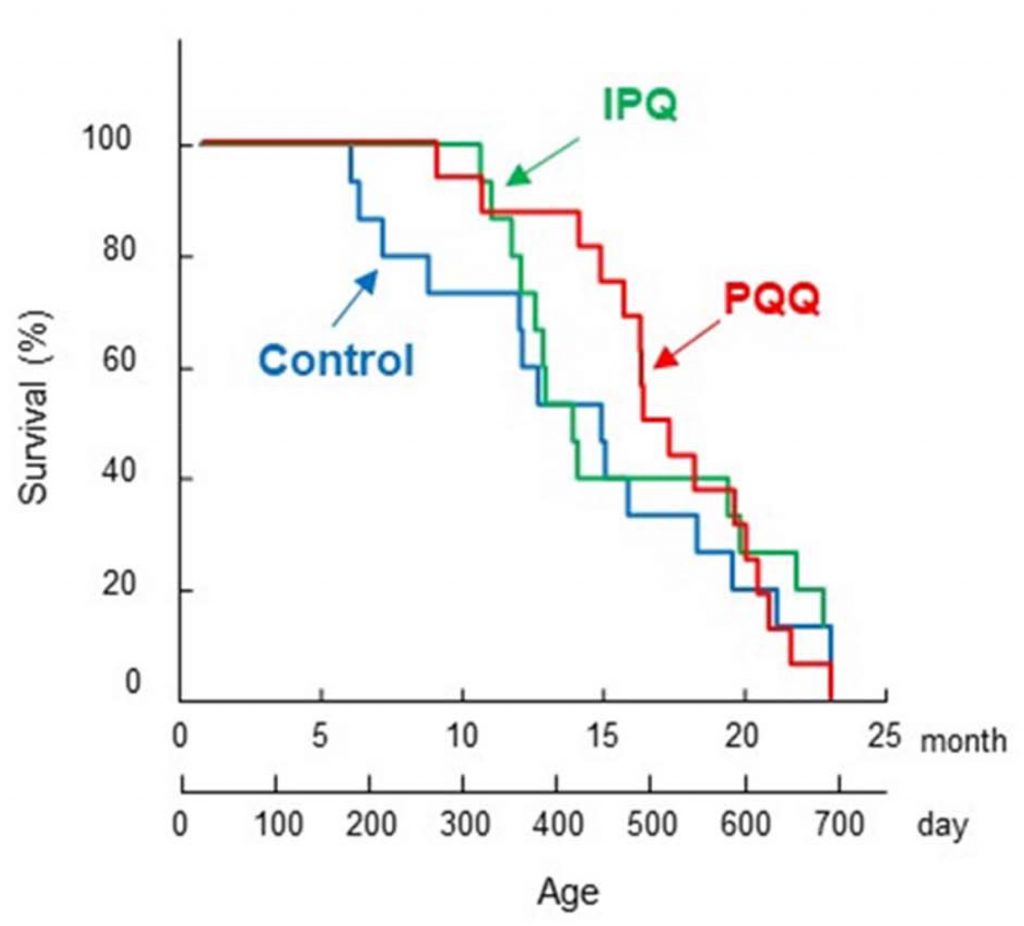
The researchers also tested imidazopyrroloquinoline (IPQ) on the lifespan of SAMP8 mice. When it reacts with the amino acid glycine, IPQ is converted into PQQ. However, unlike PQQ, IPQ is not a powerful antioxidant. Perhaps due to its lack of antioxidant activity, IPQ reduced the median lifespan of SAMP8 mice by 7.3%.
PQQ Improves Strength
To examine muscle function, the researchers measured strength. To do so, they timed how long the SAMP8 mice could hang from a wire mesh. They found that PQQ improved strength at all ages while reducing the rate of its decline. IPQ had less of an effect on strength, only modestly counteracting strength decline while improving strength during the latter stages of life.
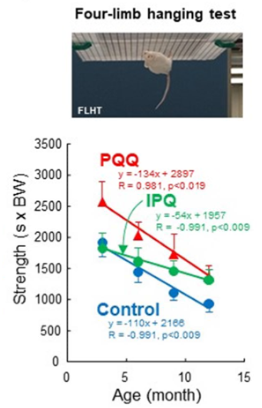
The researchers also tested the effects of beginning the administration of PQQ or IPQ during middle age. This time, the SAMP8 mice began treatment at an age roughly equivalent to what the researchers say is about 50 human years. The results showed that beginning treatment in middle age did not lead to the same strong effects on lifespan and strength observed with lifelong administration.
PQQ Supports Youthful Appearance
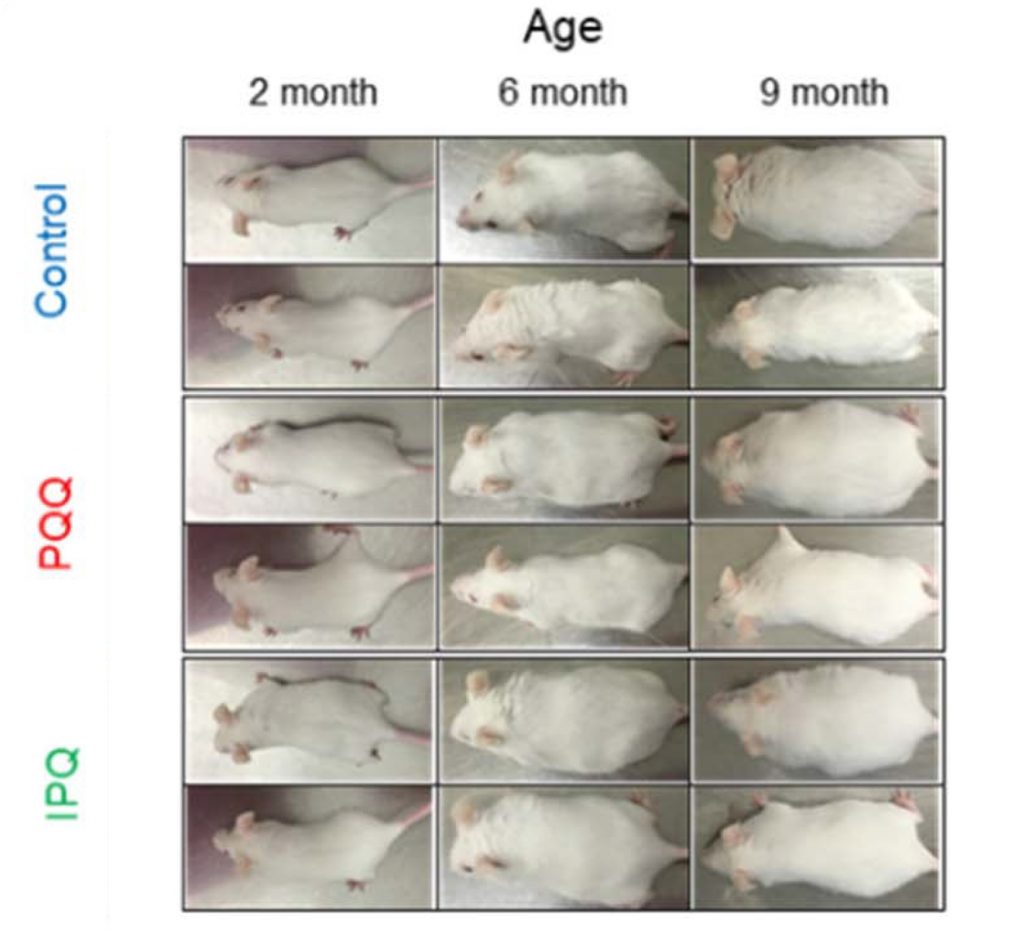
To assess outward appearances, the researchers took photographs of the aging SAMP8 mice. They found that PQQ and IPQ improved the glossiness and health of the mice’s fur. Additionally, IPQ was shown to reduce fat droplets in the fat and liver tissue of the mice. With aging, fat tends to accumulate in various organs, rendering those organs less functional.
Can PQQ Prolong the Lifespan of Humans?
The findings of the Toho University researchers show that PQQ prolongs the lifespan of SAMP8 mice. The next step is to determine whether PQQ can prolong the lifespan of naturally aged rodents. If PQQ can extend the lifespan of naturally aged rodents, more heed can be given to whether PQQ can potentially extend the lifespan of humans.
A proper human lifespan study would require following participants over their lifetime, hoping that they adhere to the treatment plan. This is why human lifespan studies are considered unfeasible and why rodent lifespan studies are considered the gold standard. Since human lifespan studies are unfeasible, future studies could explore how PQQ affects human health.
Along those lines, one study showed that PQQ improves the cognitive performance, including memory, attention, and reaction time, of healthy older adults. Moreover, in elderly adults with mild cognitive impairment, PQQ was shown to increase the concentration of brain-derived neurotrophic factor (BDNF), which plays a vital role in cognitive performance.
Cognitive impairment can lead to various forms of dementia, such as Alzheimer’s disease (AD). Since AD and dementia lower the chances of a long life, PQQ could extend lifespan by mitigating the progression of cognitive impairment. For those hedging their bets on PQQ, it can be found in supplement form in 20 mg doses, which is the dosage shown to improve cognitive performance.
 Comments