


Key Points:
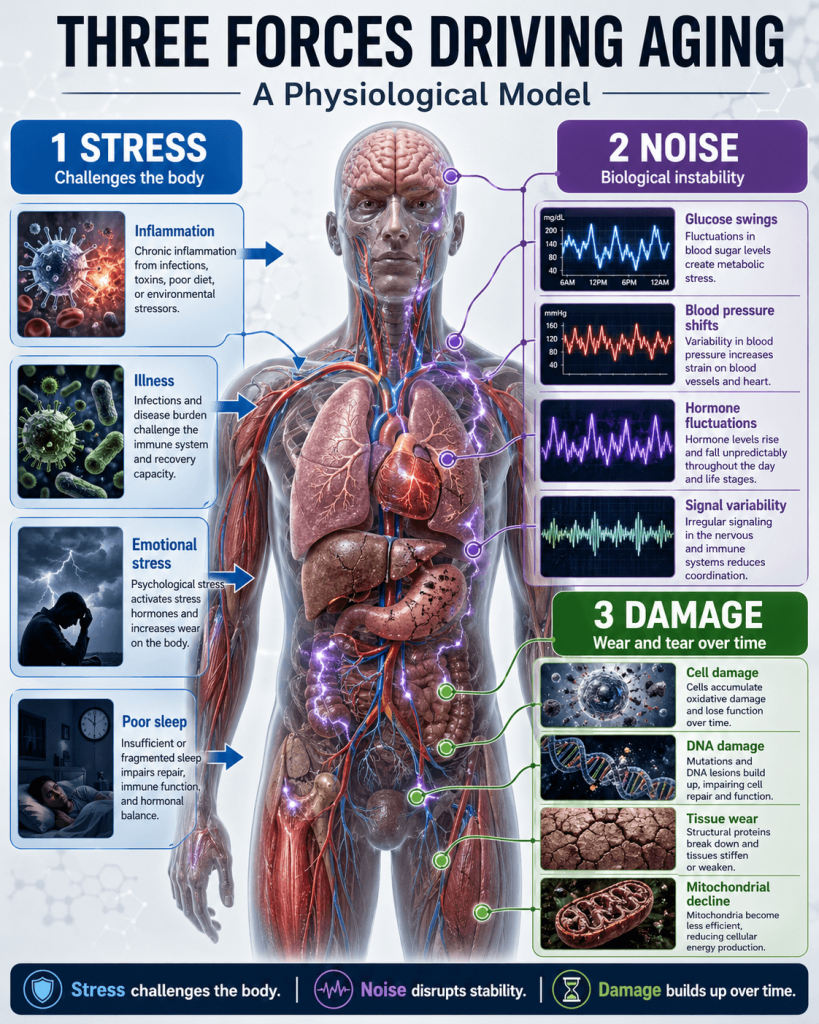
- The first variable influencing aging, stress, is anything that transiently initiates a deviation from physical, psychological, or cellular stability.
- The second variable, noise, entails the body’s small fluctuations—variable glucose levels and other day-to-day biological instability—that build up with age and push organisms from normal function into disease.
- The third variable, damage, is the slow, cumulative wear-and-tear on organisms that directly drives functional decline with age.
Peter Fedichev is a physicist turned biotech entrepreneur who co-founded and leads Gero, a longevity-focused company that uses AI and physics-based models to study aging. He received his training in theoretical physics, worked in computational drug discovery, and later shifted into aging biology and biophysics.
In a YouTube podcast segment, he described a new three-variable framework to describe how aging occurs, which contrasts with the hallmarks of aging. Along these lines, the hallmarks of aging framework seeks to map molecular, cellular, and functional changes that drive aging. It also serves as a framework that points to particular attributes, such as inflammation, to target with aging interventions. In contrast, Fedichev’s framework prioritizes a minimal, quantitative, physics-based system, as opposed to the longer descriptive list of hallmarks of aging.
More Information on Stress, Noise, and Damage
Fedichev’s framework encompasses three variables that contribute to aging: stress, noise, and damage. Stress comes from physical, psychological, or molecular stressors (such as DNA damage or protein misfolding) that lead to reversible dynamic fluctuations and drive physiological vulnerability with age, as resilience against stress declines. Moreover, noise in this framework means random fluctuations in how well biological regulatory systems maintain stable function over time, which build up with age and push organisms from normal function into disease states. Finally, damage in Fedichev’s framework refers to an irreversible accumulation of molecular changes that erode an organism’s physiological function with age.
Three Levels of Aging Interventions
Notably, targeting these three variables of aging with therapeutics may confer different degrees of lifespan extension. For example, according to Fedichev, “level 1” interventions targeting stress-related factors of aging could add about a few years to lifespan at best with current approaches. In contrast, targeting the noise variable of his aging framework with “level 2” interventions could have a much larger effect, adding around 40 years of life by shifting the average lifespan toward its natural maximum, between 120 and 150 years, according to Fedichev. Furthermore, “level 3” aging interventions would target irreversible physiological damage that accumulates with age and could push lifespan beyond the current maximum of about 120 to 150 years.
According to Fedichev, most aging interventions currently available target stress and, as such, are classified as “level 1” interventions. Examples of level 1 interventions include calorie restriction (reducing calorie intake while ensuring consumption of adequate nutrients) and rapamycin (an immunosuppressant that targets various aging pathways).
Additionally, while not currently approved for human use, Fedichev says some “level 2” interventions have already reached a plausible development path for the near future. He describes them as therapies that reduce noise rather than repair damage. He has discussed non-specified “level 2” drug candidates that control glucose spikes and stabilize blood factors; however, none of the purported candidates he referred to have been clinically validated. This makes their approval unlikely in the next 10 years or so, since human trial testing usually takes at least 10 years.
Finally, as far as “level 3” interventions go, which could push lifespan beyond its current maximum, such therapies that reverse physiological damage may come about relatively far in the future. According to Fedichev, these therapies will likely be difficult to develop. Accordingly, there may only be conceptual and early research directions for “level 3” therapies.
Substantial Lifespan Extension Through Targeting Noise and Damage
Peter Fedichev’s framework of aging, based on mathematical computations and his background in physics, perhaps offers a more straightforward approach to aging than the hallmarks of aging framework. Fedichev’s framework highlights significant barriers, such as physiological noise and damage, that could be therapeutically targeted for humans to achieve substantial gains in lifespan extension. Addressing these variables with future “level 2” interventions for noise and “level 3” interventions for damage may serve as key ways to dramatically extend lifespan beyond the currently available “level 1” interventions for stress.
Fedichev’s framework emphasizes that aging is a decline in resilience, not just the onset of age-related physiological dysfunction. This suggests that the most effective way to prevent age-related diseases is to stabilize the system’s ability to recover from molecular stressors that occur throughout life. Hence, the notion of targeting noise, the small, random physiological fluctuations, and reversing damage with “level 2” and “level 3” interventions, respectively, could provide aging scientists with a useful, physics-based approach to fight aging.
 Comments