


Key Points:
- Previous research has demonstrated that aging clocks that analyze molecular tagging patterns on DNA (epigenetic aging clocks) predict mortality better than the number of years people have lived.
- Building on that finding, this study shows that using epigenetic aging clocks to take multiple age readings over time predicts mortality better than a single reading.
- These results suggest that dynamic changes in the pace of aging, as measured with these clocks, reflect an evolving physiological state with age that may serve as a sensitive indicator for testing aging interventions.
The geroscience hypothesis is the idea that targeting biological mechanisms of aging can delay, prevent, or reduce the severity of multiple age-related diseases and possibly extend lifespan. According to the hypothesis, in targeting biological mechanisms of aging, therapeutics can intervene against age-related diseases all at once, rather than treating each disease separately.
In line with the geroscience hypothesis, aging scientists often use measurements of biological age (an age measurement based on cell and tissue function, rather than the number of years one has lived) to assess whether therapeutics target the biological mechanisms of aging. As this line of thinking goes, slowing the pace of biological aging may prevent or delay the onset of age-related diseases and possibly extend the portion of life spent in good overall health. As a first step to address the goal of slowing biological aging, researchers must develop biological age measurement methods that can identify fast-aging individuals to track the effectiveness of interventions against aging.
Now, as published in Nature Aging, scientists from the National Institute on Aging in Baltimore present data showing that faster aging, measured at either two or three time points with seven biological aging clocks over 24 years, robustly predicted a higher risk of death, outperforming a single reading. Since the measurements of biological age taken at multiple time points predicted mortality better than a single measurement, this finding suggests that changes in the pace of aging occur over time, which can be more accurately captured with multiple biological age readings. Also, the evidence suggesting the pace of aging can change underscores the potential to evaluate multiple biological age readings over time to determine whether interventions slow aging.
Background on Epigenetic Aging Clocks
To measure biological age, the National Institute on Aging researchers utilized epigenetic aging clocks—statistical models that estimate biological age based on molecular tagging patterns on DNA (DNA methylation patterns). Interestingly, these clocks can evaluate DNA methylation patterns across the complete set of genetic instructions made of DNA (the genome) to predict biological age.
Taking Multiple Readings of Biological Age Outperformed Single Readings for Most Epigenetic Aging Clocks Used
To test whether multiple epigenetic aging clock measurements outperform single measurements in predicting mortality, the researchers evaluated a database that included DNA methylation profiles from 699 European adults with an average age of about 63 years. For 376 of these adults, DNA methylation data were available at two time points, and for 323 participants, the data were available for three time points. The researchers applied seven epigenetic aging clocks to the DNA methylation profiles for biological age readings.
To analyze whether multiple measurements of biological age outperform single measurements, the Boston-based researchers first generated hazard ratios. For this study’s purposes, hazard ratios measure the rate of death based on biological age measurements. A hazard ratio of 1.0 reflects having the same rate of death compared to the average, while a hazard ratio above 1.0 reflects a higher rate of death than average. For example, a hazard ratio of 1.23 predicts that the participants will die at a rate 23% higher than the average.
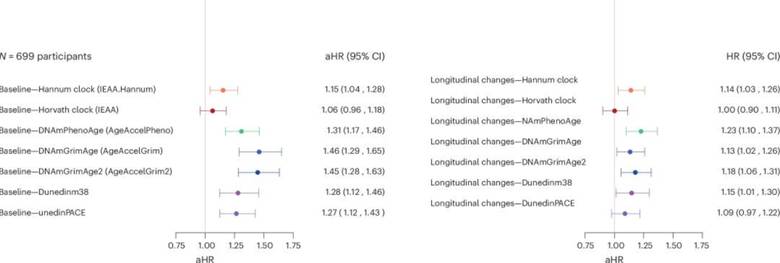
Once the researchers gathered hazard ratios, they assessed the accuracy of the hazard ratios. Of the epigenetic aging clocks assessed, DNAmGrimAgv.2, DNAmGrimAge, DNAmPhenoAge, and DunedinPACE performed best. According to their analysis, measuring biological age at multiple time points with these clocks significantly outperformed a single measurement. Because measuring biological age at multiple time points more accurately predicted the rate of mortality, this finding suggests that aging processes fluctuate in ways that multiple measurements detect better than single measurements.
Using Epigenetic Aging Clock Readings at Multiple Time Points to Assess Interventions
This study provides evidence that aging processes fluctuate over time and that taking multiple epigenetic aging clock readings can capture these fluctuations better than single readings. Thus, the notion of capturing the fluctuations with multiple readings suggests the clocks can serve as indicators of whether an intervention slows aging processes. As such, if multiple readings had not outperformed single readings, this would suggest that testing an intervention’s effects across multiple readings over time does not indicate anything significant occurring related to aging processes.
While more detailed studies will be required to uncover what alterations to cellular mechanisms the DNA methylation changes associated with these clocks reflect, the evidence here suggesting they can capture fluctuations in aging processes paves the way for testing interventions. In that regard, researchers could start by taking a group of aged adults and giving them baseline epigenetic age tests. Then, after months or years of giving the participants an intervention, such as Restorin, which is roughly based on SRN-901 (a drug that extended the remaining lifespan of aged mice by 33%), follow-up tests could be taken. If such an intervention was shown to slow biological aging compared to non-treated participants, the data from this study would support the notion that the intervention modulated currently undefined physiological processes to slow aging.
 Comments