


Key Points:
- NR restores memory in sleep-deprived rats.
- The NAD+ booster also alleviates depression in these rats.
- NR suppresses aggression in the sleep-deprived rats.
Just one night of sleep deprivation has been shown to increase a protein called amyloid-beta (Aβ) in the brain. Aβ tends to accumulate with age, potentially leading to the formation of plaques associated with Alzheimer’s dementia. By supporting the formation of Aβ plaques, sleep deprivation may set the stage for accelerated brain aging and Alzheimer’s dementia.
In a recent pre-print study, researchers may have found a way to prevent the brain aging effects of sleep deprivation. They show that NR counters the cognitive and behavioral deficits associated with sleep deprivation and Aβ plaques in rats. While getting a good night’s sleep clears out Aβ, this study suggests that NR could at least mitigate the effects of sleep deprivation.
NR Restores Memory in Sleep-Deprived Rats
To test the effect of NR on sleep deprivation, the researchers deprived rats of sleep for five days. Before sleep deprivation, the rats were injected in the brain with Aβ to accelerate the neurodegenerative process. Following deprivation, the rats were fed NR daily for 23 days before being subjected to cognitive and behavioral tests.
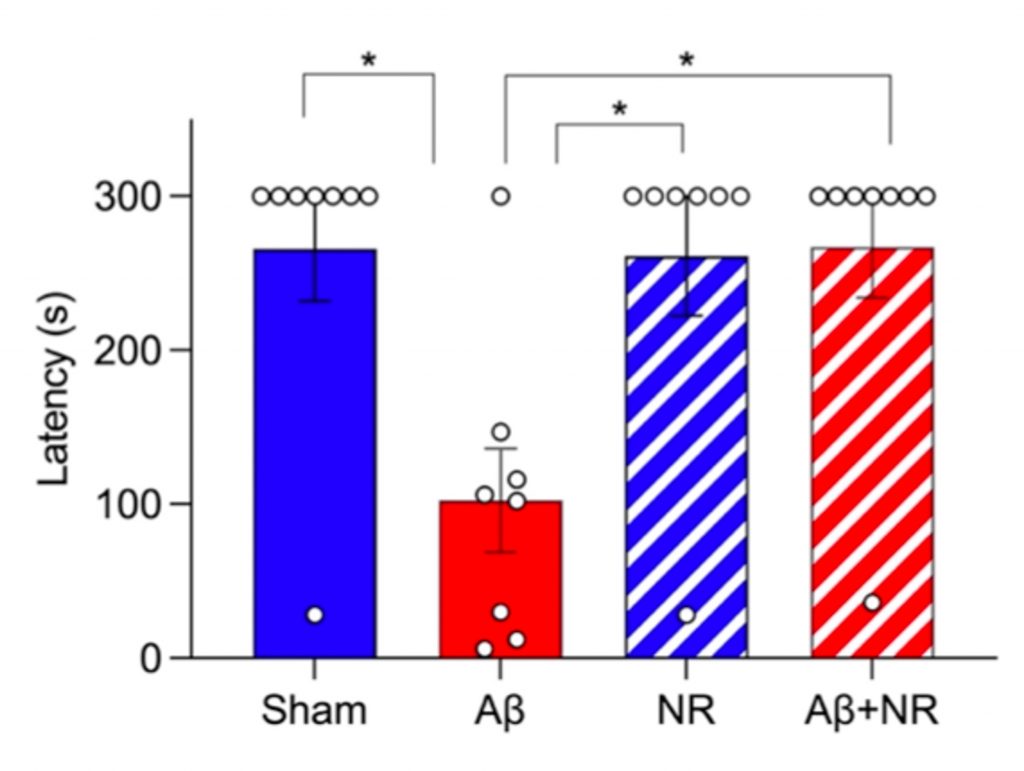
To test learning and memory, the researchers taught the rats that entering a dark room causes a foot shock. When tested, normal, well-rested rats took about four minutes to enter the dark room, suggesting they had remembered and were cautious of the foot shock. On the other hand, sleep-deprived rats injected with Aβ took less than two minutes to enter the dark room, suggesting they had forgotten the danger of the foot shock. While NR did not affect the normal rats, in the sleep-deprived Aβ-injected rats, it restored the time it took to enter the dark room. These findings point to NR restoring associative memory in sleep-deprived rats with Alzheimer’s pathology.
NR Alleviates Depression in Sleep-Deprived Rats
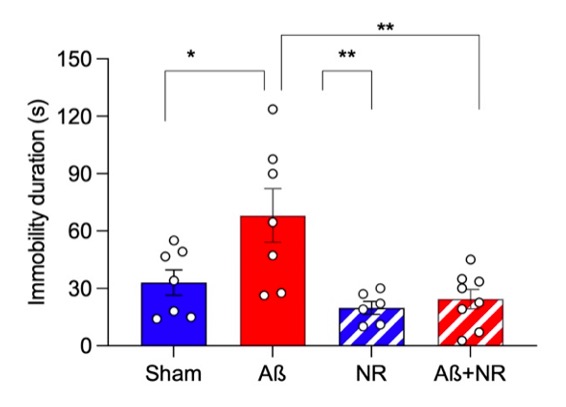
Most individuals with Alzheimer’s disease suffer from one or more behavioral disorders, such as depression. To assess depressive-like behavior, the researchers held the rats by the tail until they became immobile. The normal rats were immobile for about 30 seconds, indicating a zest for escaping. However, the sleep-deprived Aβ-injected rats were immobile for nearly double the time, suggesting they had given up. While NR had no effect on the normal rats, it restored the immobility time in sleep-deprived Aβ-injected rats. These findings suggest that NR alleviates depressive-like symptoms associated with Alzheimer’s and sleep deprivation.
NR Suppresses Aggression in Sleep-Deprived Rats
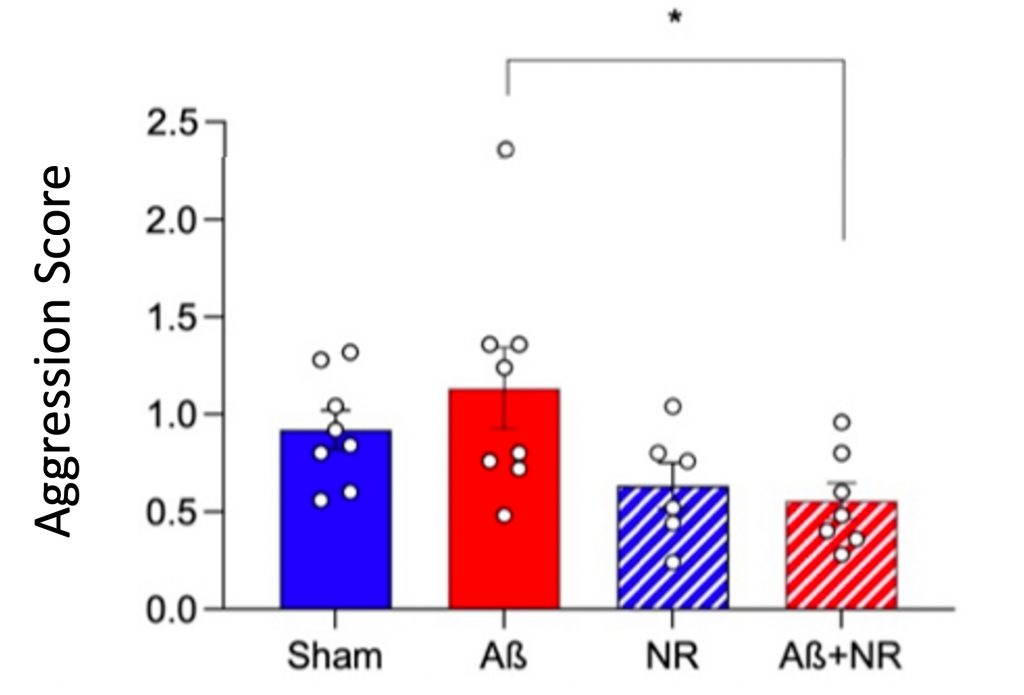
Another behavioral disorder exhibited by Alzheimer’s patients is aggression. To assess aggression, the researchers handled the rats and scored them based on how much they attacked the handler’s hand. The sleep-deprived Aβ-injected rats tended to be more aggressive than normal, but this was not statistically significant. Still, NR reduced aggression in the sleep-deprived Aβ-injected rats while having no effect on the normal rats. These findings suggest that NR reduces aggression in sleep-deprived rats that model Alzheimer’s disease.
Boosting NAD+ to Slow Brain Aging from Sleep Deprivation
While there is no substitute for sleep, boosting NAD+ may mitigate some effects of sleep deprivation. Namely, the study suggests that boosting NAD+ counters some of the cognitive and behavioral deficits associated with sleep deprivation. Whether this occurs in rats that have not been injected with Aβ remains to be studied.
Previous Studies Show that Boosting NAD+ Counters Brain Aging
Previous studies have shown that boosting NAD+ with its precursors, like NMN (nicotinamide mononucleotide), counters the cognitive decline associated with Alzheimer’s. One study showed that NMN alleviates memory loss and neurodegeneration in a mouse model of Alzheimer’s. In the same study, mitochondrial stress was detected in Alzheimer’s patients. It is therefore possible that boosting NAD+ counters brain aging by improving the health of mitochondria.
In a previous clinical trial, a cocktail of compounds, including NR, was shown to prevent neurodegeneration and improve cognition in Alzheimer’s patients. The cocktail was also shown to improve mitochondrial function, supporting the notion that boosting NAD+ targets mitochondria. Many studies have shown that elevating NAD+ improves mitochondrial function, especially when combined with other compounds, particularly antioxidants.
Sleep Deprivation Exacerbates Brain Aging, which NAD+ Counteracts
Mitochondrial dysfunction is increasingly acknowledged as one of the primary drivers of aging and neurodegenerative diseases. Thus, by improving mitochondrial function, cellular energy levels may increase, oxidant levels may decrease, and inflammation may decrease. Like mitochondrial dysfunction, oxidative stress (damage caused by oxidants) and inflammation are increasingly acknowledged as drivers of neurodegeneration.
Sleep deprivation promotes mitochondrial dysfunction, oxidative stress, and inflammation, contributing to the acceleration of brain aging. By reducing these drivers of aging, boosting NAD+ with its precursors, such as NR, NMN, or niacin, could potentially slow the brain aging process, which is exacerbated by a lack of sleep. One product that may counter the aging effects of sleep deprivation is Enlivein. Enlivein contains NR and other anti-aging interventions designed to make up for lost sleep.
 Comments