


Key Points:
- A natural antioxidant, α-lipoic acid, improves cognitive function in aging mice to levels comparable to those of young mice.
- α-lipoic acid reduces neuroinflammation in the aged hippocampus, which is crucial for learning and memory.
- These findings indicate that α-lipoic acid may be a promising treatment for cognitive decline in the elderly.
A cell-made compound sold as a supplement has shown promising results in aging research. Scientists at the Second Hospital of Hebei Medical University in Shijiazhuang, China, report that α-lipoic acid, a small molecule produced in mitochondria, significantly restored memory and reduced brain inflammation in elderly mice after a couple of months of treatment. As millions worldwide use α-lipoic acid for metabolic and nerve-related conditions, this study emphasizes the significance of studying its impact on human brain aging.
Old mice, young performance
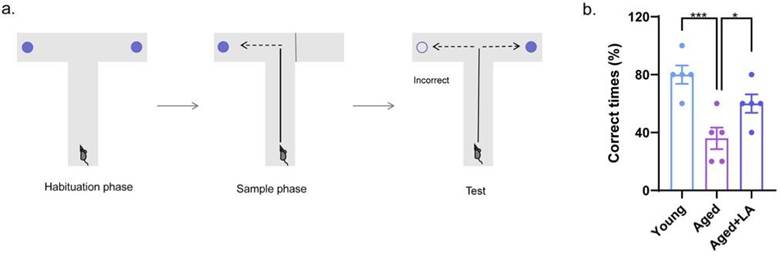
To assess learning, memory, and decision-making, co-first authors Zhenyuan Zhang and Cong Zhang employed a well-known test called the T-maze. Here, a mouse is placed at the base of the T and chooses between two arms, typically to find a reward, such as food, or avoid a previously visited arm, allowing researchers to measure their ability to recall their surroundings (spatial memory) and ability to change decisions as needed (cognitive flexibility).
The difference between young and old animals was dramatic. Young mice made the correct choice about 80% of the time. Aged mice barely cleared 36%—clear evidence of age-related memory impairment. But when aged mice received daily doses of α-lipoic acid for two months, their performance jumped to around 60%, a substantial recovery of working memory. It didn’t just slowly decline—it partially reversed it.
Less brain damage and inflammation
Memory improvement was only part of the story. The scientists also looked inside the brain—specifically the hippocampus, a region essential for learning and memory.
Aging mouse brains showed classic signs of inflammation (i.e., neuroinflammation):
- Overactive microglia, the brain’s immune cells
- Highly activated astrocytes, support cells that signal distress
- Elevated inflammatory molecules
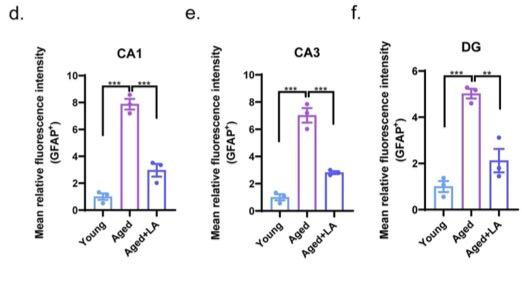
After treatment with α-lipoic acid, pro-inflammatory cytokines decreased, and microglial and astrocyte activation in key hippocampus regions decreased by about 50%.
The authors make some major claims about the effects of α-lipoic acid treatment on cognition and brain inflammation. First, animals with the greatest inflammation drops had the greatest memory improvements. Second, in some brain regions, inflammation and cognitive performance were almost inversely related. Unfortunately, these results are correlative and cannot prove cause and effect, which would require more experiments. So, take those claims with a grain of salt.
Why α-lipoic acid?
This is not a synthetic drug designed only for mice but a naturally occurring compound that is:
- Made naturally in mitochondria
- Essential for energy metabolism
- A potent antioxidant
- Already used clinically to treat diabetic nerve damage
Over the past decade, researchers have shown that α-lipoic acid can protect neurons in mouse models of Alzheimer’s disease, Parkinson’s disease, and stroke. But whether it could counteract the slow, natural cognitive decline of normal aging was still unclear. This study shows that α-lipoic acid can protect against the gradual cognitive decline that comes with aging.
Flipping the brain’s inflammatory switch
Digging deeper, the team uncovered a key molecular mechanism.
Aging suppresses a protective protein called PPAR-γ, sometimes described as a master regulator of inflammation and metabolism, while activating NF-κB, a powerful driver of inflammatory responses.
α-lipoic acid reversed both trends.
- PPAR-γ levels rose
- NF-κB signaling was dampened
- Inflammatory gene activity fell
To confirm this pathway mattered, researchers repeated the experiments in cultured brain immune cells and blocked PPAR-γ. When they did, α-lipoic acid lost its anti-inflammatory effect, showing that, on the level of molecules, α-lipoic acid treatment isn’t just correlated to reduced inflammation—it causes it.
This mechanism fits neatly with earlier clinical observations. Drugs that activate PPAR-γ, such as pioglitazone, have already been linked to a lower risk of Alzheimer’s disease in people with mild cognitive impairment.
A supplement with real-world relevance
One reason this study stands out is its translational relevance. The dose of α-lipoic acid given to mice—when adjusted for body size—is well within the range already used safely in humans, typically around 600 mg per day. Indeed, across trials, α-lipoic acid is generally well tolerated, with mostly mild side effects (e.g., gastrointestinal upset, dizziness, occasional hypoglycemia), and serious adverse events are rare, making it one of the better-studied antioxidant supplements in human medicine.
In human clinical trials, α-lipoic acid has shown promise in reducing pain and improving nerve function in diabetic peripheral neuropathy, especially at doses around 600 mg/day (oral or IV). A meta-analysis shows that the effects of α-lipoic acid on glycemic control, insulin sensitivity, body weight, and some cardiometabolic markers are modest and inconsistent across studies. As of now, there is no convincing clinical evidence for the benefits of α-lipoic acid on dementia or cognitive decline.
Important caveats
Despite the excitement, the researchers are careful to emphasize limitations.
- This was a mouse study, not a human trial
- Sample sizes for some molecular tests were small
- The study focused on brain inflammation, not possible effects elsewhere in the body
- Cognitive aging in humans is far more complex than in laboratory animals
Still, as proof of principle, the findings are compelling.
A broader message about brain aging
Beyond α-lipoic acid itself, the study reinforces a growing idea in neuroscience: brain aging is not just about neuron loss—it’s about chronic inflammation. Microglia and astrocytes, when persistently activated, can quietly erode brain function over decades. Interventions that restore immune balance and quell inflammation may offer a powerful way to preserve cognition, even late in life. As scientists continue to investigate ways to target inflammation, this mitochondria-made molecule might turn out to be surprisingly important.
 Comments