


Key Points
- A garlic-derived compound increased circulating eNAMPT, a protein linked to healthy aging.
- Long-term treatment improved muscle strength and reduced frailty in aged mice.
- Healthy middle-aged adults also showed higher circulating eNAMPT after supplementation.
Loss of muscle strength is one of the earliest and most important biological changes that accompanies aging. Adults lose approximately 3–8% of skeletal muscle mass per decade after age 30, and that decline accelerates later in life. Reduced muscle strength increases the risk of falls, frailty, hospitalization, and loss of independence, making preservation of muscle function a major goal of healthy aging research.
Scientists have discovered that muscle aging is influenced by communication between multiple organs. Fat tissue, for example, releases proteins that regulate metabolism, brain function, and the way skeletal muscle responds to aging. One of these proteins is extracellular nicotinamide phosphoribosyltransferase (eNAMPT), which circulates through the bloodstream and helps maintain levels of NAD⁺ (a molecule required for cellular energy production and repair). Previous studies have shown that circulating eNAMPT declines with age, while restoring the pathway in mice improves physical function and several markers of healthy aging.
Scientists have searched for practical ways to stimulate this pathway naturally. One candidate is S-1-propenyl-L-cysteine (S1PC), a sulfur-containing compound produced during the aging of garlic extract. Although aged garlic has long been studied for cardiovascular and metabolic health, the biological actions of S1PC have remained poorly understood.
To investigate, researchers tested whether S1PC could activate eNAMPT signaling and improve physical function during aging. The study, published in Cell Metabolism, combined molecular experiments, long-term studies in aged mice, and a clinical trial in healthy middle-aged adults.
Garlic Compound Increased Release of an Anti-Aging Protein
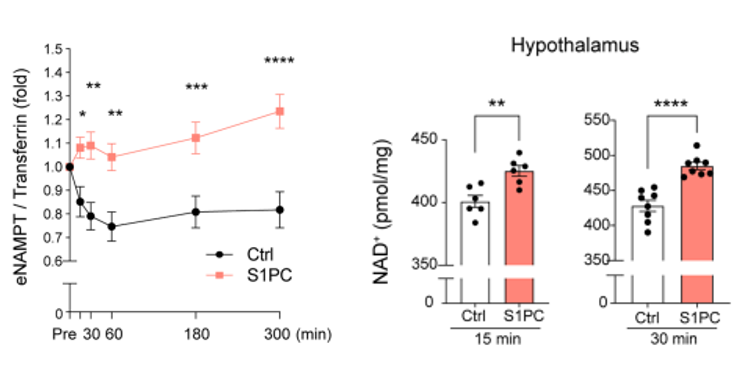
The researchers first examined how S1PC affected fat cells. Treatment activated LKB1, an enzyme that regulates cellular energy balance. LKB1 then stimulated SIRT1, a protein involved in metabolism and cellular maintenance.
Activation of this pathway increased the release of eNAMPT from fat tissue inside tiny membrane-bound particles called extracellular vesicles, which transport proteins between cells. After entering the bloodstream, these vesicles accumulated within the hypothalamus, a region of the brain that coordinates metabolism and many aspects of aging. When the researchers blocked eNAMPT production, the downstream biological effects largely disappeared, demonstrating that this signaling pathway was required for the response.
Previous studies have shown that circulating eNAMPT supports NAD⁺ production in distant tissues after being released from fat cells. NAD⁺ serves as an essential cofactor for hundreds of metabolic reactions, including those involved in energy production, DNA repair, and cellular stress responses. As circulating eNAMPT declines during aging, many organs gradually lose part of their ability to maintain these processes. Increasing eNAMPT secretion may therefore help restore communication between tissues that normally weakens with age.
Long-Term Treatment Improved Muscle Strength and Reduced Frailty
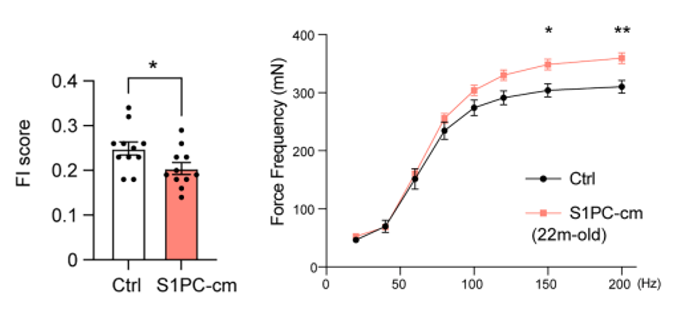
The investigators next asked whether activation of this pathway translated into measurable improvements in healthy aging. Aged mice receiving S1PC developed stronger forelimb grip strength than untreated animals throughout the study. They also performed better on a standardized frailty assessment that measures multiple age-related changes in physical condition, including posture, activity, and overall health.
Body weight and muscle mass remained similar between groups, indicating that stronger muscles did not result from larger muscles. This distinction is important because muscle strength often declines more rapidly than muscle size during aging. Older adults can lose substantial force production even before significant muscle wasting develops, reflecting changes in nerve signaling, mitochondrial function, and muscle quality.
The preservation of grip strength without measurable increases in muscle mass suggests that S1PC improved how existing muscle tissue functioned rather than increasing the amount of muscle itself. When the researchers prevented eNAMPT signaling, these improvements largely disappeared, confirming that activation of this pathway was necessary for the physiological benefits.
Healthy Adults Also Produced More Circulating eNAMPT
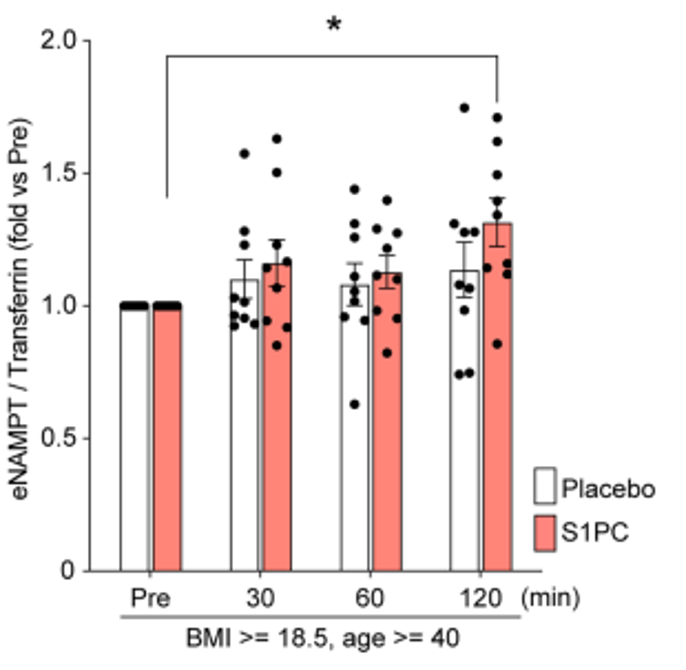
The investigators then asked whether S1PC produced similar biological changes in people. Healthy middle-aged adults consumed S1PC daily for twelve weeks. Blood samples showed a significant increase in circulating eNAMPT after supplementation. The response was strongest among participants with healthy amounts of body fat, while individuals with greater adiposity showed little change.
Fat tissue undergoes important biological changes during aging and obesity. Healthy adipose tissue actively releases signaling molecules that regulate metabolism throughout the body, whereas dysfunctional fat tissue becomes more inflammatory and less responsive to normal physiological signals. The researchers propose that these differences may help explain why participants with healthier adipose tissue generated a stronger eNAMPT response after supplementation.
The clinical study measured molecular changes in the bloodstream but did not evaluate muscle strength, frailty, or physical performance. Whether increasing circulating eNAMPT produces the same functional benefits observed in mice remains an important question for future clinical trials.
Healthy Aging Depends on Communication Between Organs
Loss of muscle strength has traditionally been viewed as a problem that begins within skeletal muscle. Research over the past decade has revealed a more complex picture. Aging gradually weakens communication between organs as fat tissue releases fewer regulatory molecules, the hypothalamus receives weaker metabolic signals, and tissues lose part of their ability to coordinate the physiological processes that maintain physical function. Declining circulating eNAMPT has emerged as one feature of this broader process, linking age-related changes in adipose tissue to reduced NAD⁺ availability throughout the body.
The present study strengthens that model. S1PC increased the release of eNAMPT from fat tissue, enhanced signaling to the hypothalamus, improved muscle strength, and reduced frailty in aged mice. Healthy middle-aged adults also developed higher circulating eNAMPT after supplementation, demonstrating that the same molecular pathway remains responsive in humans.
The study does not establish that garlic supplements slow human aging. The clinical trial measured circulating eNAMPT for twelve weeks and did not evaluate muscle strength, mobility, or long-term health outcomes. Larger clinical studies will be needed to determine whether sustained activation of this pathway preserves physical function in older adults. Even so, the findings identify a promising biological target for healthy aging. Restoring the signals that coordinate multiple organs may prove just as important as preserving the function of individual tissues as people grow older.
 Comments