


Not long ago, Harvard University Professor David Sinclair, PhD, told podcaster and comedian Joe Rogan that “nothing’s gone wrong so far” with Life Biosciences’ human trial. Now, Life Biosciences has announced that three people with open-angle glaucoma tolerated its investigational therapy, ER (epigenetic reprogramming)-100, through eight weeks of follow-up. Two participants also showed improvements in portions of their visual fields—the area they can see while looking straight ahead.
The October 8 announcement offers an early glimpse of how a reprogramming-based therapy might perform in patients. However, the findings remain preliminary. They come from the first three participants at the trial’s lowest dose, without a randomized control comparison, and do not directly demonstrate that the treatment made their cells biologically younger.
How ER-100 Is Intended to Work
ER-100 delivers three genes: OCT4, SOX2, and KLF4, collectively known as OSK. These proteins are transcription factors, meaning they modulate which genes are turned on or off. Life Biosciences is investigating whether activating these genes can restore more youthful patterns of cellular function through a process called partial epigenetic reprogramming.
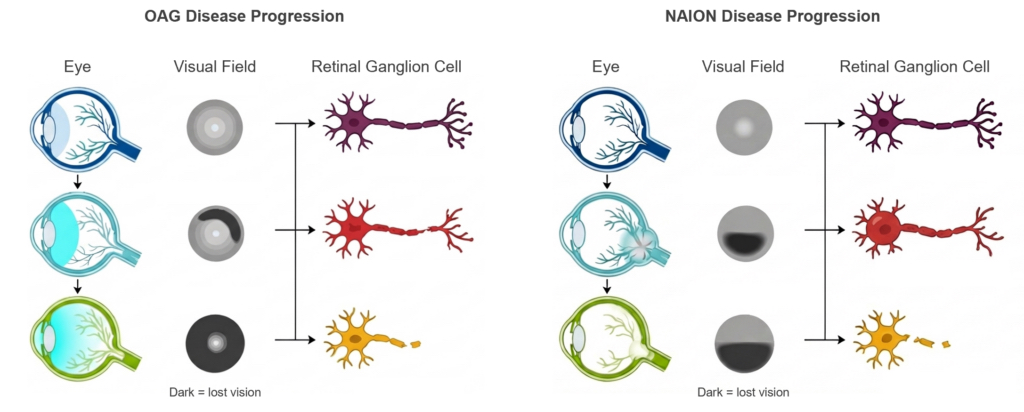
As part of the overarching goal of the trial, researchers are evaluating the effect of ER-100 on people with optic neuropathies, conditions involving damage to the optic nerve. The broader program includes both open-angle glaucoma (OAG) and non-arteritic anterior ischemic optic neuropathy (NAION), although the newly reported results concern glaucoma participants only.
Procedure
Treatment begins with a single intravitreal injection—an injection into the eye—using a delivery system that harnesses the ability of (adeno-associated) viruses to get genes into cells. Participants then take doxycycline daily for 8 weeks to activate the OSK genes. The genes were engineered to be activated by this antibiotic. To reduce the immune response from the gene therapy, the participants also received an anti-inflammatory drug, prednisolone.
What the First Safety Results Show
The first three participants received the lowest dose of ER-100 being evaluated. Through Day 56, the company reported no toxicities or serious adverse events. Other adverse events were reported, but the company attributed them to the injection procedure, prednisolone treatment, or pre-existing conditions. As a result, the trial’s Data Safety Monitoring Board recommended increasing the dose by 3-fold.
These observations support initial tolerability under the study’s conditions. However, three participants followed through eight weeks cannot establish long-term safety or reliably reveal uncommon adverse effects. Those questions require more patients and longer observation.
Two Participants Showed Visual-Field Improvements
Alongside safety, investigators assessed visual function using Humphrey Visual Field testing, a computerized diagnostic tool. Life Biosciences reported improvements at Day 56 in two of the three participants. In each of those two individuals, at least 28% of tested visual-field locations improved by more than four decibels.

The numbers need careful interpretation. A visual-field test samples light-detection sensitivity at different locations. The reported percentage describes how many of those locations exceeded a specified improvement threshold—not the percentage by which a person’s overall vision improved. “At least 28% of locations improved” therefore should not become “vision improved by 28%.”
The result is potentially encouraging because it concerns a functional measurement rather than only a proposed molecular mechanism. Nevertheless, the announcement does not establish whether those changes translated into noticeable improvements in daily life. It also provides insufficient detail to judge the consistency and overall magnitude of benefit across participants.
What Comes Next
The dose-escalation recommendation gives investigators a path to continue testing ER-100. As the trial progresses, additional participants and longer follow-up should help clarify its safety profile and whether the early visual-function findings persist or recur. Establishing efficacy will require larger, controlled studies capable of determining whether improvements are attributable to the treatment.
For the cellular-reprogramming field, these results represent a meaningful but limited clinical step. Researchers now have initial human observations rather than only a proposed therapeutic mechanism. The appropriate takeaway is an early signal worth investigating—not proof that rejuvenation has been achieved.
 Comments