


Key Points
- Researchers created a platform that tests potential lifespan-extending drugs across five laboratory models—yeast, worms, flies, fish, and mice—to identify candidates with effects that may be conserved across species.
- In a systematic comparison of 423 compounds in yeast, worms, and flies, 130 extended lifespan in at least one species and 32 did so in at least two; metformin, rifampicin, and furazolidone were positive in all three fast-screening models.
- Nevertheless, of the 423 compounds tested, no compound extended lifespan across all five animal models.
Aging is a major risk factor for many chronic diseases, so researchers have been interested in drugs that can improve healthspan (the years spent in good overall health) and tested them in various animal models. One obstacle in tackling how to optimize aging is that a compound that looks impressive in a single animal model often fails to reproduce its effects in other animals, including mammals. What if researchers could look for medicines that support healthier aging by testing the same drug candidates across an evolutionary ladder: in yeast, tiny worms, fruit flies, fish, and mice?
Now, as published in Aging Cell, Ocampo and colleagues from the University of Lausanne in Switzerland describe a platform designed to solve part of that problem. The platform systematically screens potential longevity drugs in multiple species using standardized, increasingly sophisticated tests. The researchers evaluated 423 compounds across thousands of experimental conditions to discover drugs that may extend lifespan.
They found that the drugs metformin (a diabetes medication), rifampicin (an antibiotic), and furazolidone (another antibiotic) conferred pro-longevity effects in yeast, worms, and flies. However, none of the 423 drugs tested conferred pro-longevity effects across all five animal models tested. These findings underscore that no single drug works across all animal models and that positive preclinical signals related to lifespan extension are only starting points; human clinical trials are necessary to confirm efficacy in humans.
Why Discovering Drugs for Healthy Aging is Hard
Lifespan extension experiments are slow, expensive, and technically difficult, especially in mammals. Different animals process drugs differently, eat different diets, and face different causes of death. A longer lifespan can also be misleading if a substance changes food intake, kills bacteria the animal eats, reduces reproduction, or causes harm that distorts survival results. For these reasons, testing across species offers a useful filter: if a compound works repeatedly in very different organisms, researchers may have more confidence that it affects a fundamental biological process rather than a species-specific quirk.
What the Researchers Built
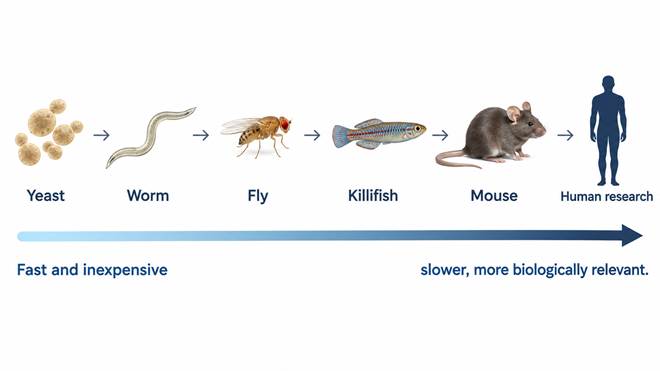
The researchers designed a platform to test for lifespan extension across five animal models: yeast, worms, flies, fish, and mice. The following table lists some of the advantages of using each animal model:
| Model organism | Why scientists use it | What it adds to the pipeline |
| Yeast | Cheap, fast-growing single-celled organism | Enables rapid early screening of many compounds |
| Roundworms (C. elegans) | Short lives and well-studied aging biology | Lets researchers test candidates in a whole animal quickly |
| Fruit flies | More complex physiology and behavior | Adds a more complex animal model, including sex-specific effects |
| African killifish | Very short-lived vertebrate | Provides a faster bridge from invertebrates to mammals |
| Mice | Mammals with physiology closer to humans | Offers the most relevant preclinical test in this study |
The team automated much of the work, making large-scale lifespan testing more feasible. The platform utilized miniaturized yeast assays that assess cellular longevity. In worms, image-analysis technology helped score movement and death. In flies, scanners were used to repeatedly monitor vials rather than relying solely on labor-intensive handling. In fish and mice, the researchers focused on practical drug delivery through food and on confirming whether the compounds actually reached the animals’ tissues. The value of the platform comes not just from a list of drugs with positive effects; it serves as a reusable workflow other scientists can inspect, reproduce, and improve upon.
What the Study Found
The integrated dataset obtained from the researchers’ application of the platform included 423 distinct compounds. Of those, 130 showed a positive lifespan result in at least one model, and 32 did so in at least two models. The study highlighted a smaller group of compounds with effects that appeared in multiple species, including metformin, rifampicin, and furazolidone in three models.
Also, several familiar compound classes appeared among these results. These included the following:
- Forskolin (a plant-derived compound involved in metabolism and cellular signaling)
- Astaxanthin (an antioxidant)
- Taurine (a sulfur-containing molecule that modulates cellular stress and inflammatory pathways)
- Resveratrol (a plant-derived compound with antioxidant and anti-inflammatory properties)
- Baicalein (a plant-derived compound found to have antioxidant and anti-inflammatory properties)
The most important finding may be how rarely a drug works consistently across all five animal models tested. No compound was shown to significantly extend lifespan across all species in the project. This, however, is not a failure; rather, it illustrates why human trial testing is required to confirm efficacy against aging; pro-longevity effects in one species may not translate to others, including humans.
What This Does and Does Not Mean for People
The platform could help researchers spend less time and money pursuing aging intervention candidates. Along these lines, it may identify interventions worth testing more rigorously in mammals and, eventually, in human clinical trials. Looking for effects that recur across distant species may reveal conserved aging pathways—biological systems that have persisted through evolution. Moreover, publicly detailed workflows, based on the platform put forth in this study, can make longevity research more reproducible and easier for other groups to challenge and validate.
Nonetheless, the study did not show that any tested drug extends human lifespan, and it did not establish that the highlighted substances are safe and effective for use against aging. Accordingly, based on the study, readers are not encouraged to self-medicate with prescription drugs listed or take high-dose supplements.
Furthermore, the results pertaining to lifespan only represent one outcome. A drug could lengthen life without necessarily improving mobility, cognition, or overall quality of life. As such, a lifespan result in yeast, worms, flies, fish, or mice is a clue—not a prescription.
A Better Map, Not a Miracle Cure
The platform presented by the Swiss researchers in this study provides an infrastructure for longevity drug discovery. The study’s contribution is a disciplined process encompassing testing compounds broadly, verifying across animal models, ruling out false signals, and advancing only the strongest candidates for human clinical trial testing. In this way, the new platform may improve early-stage research on aging intervention drugs that can ultimately make human trial testing smarter, but still, human trials remain essential.
The most encouraging part of this research is not that it has found a proven longevity drug. It has created a more demanding way to search: asking for evidence of potential treatments to perform across multiple forms of life before they earn the right to move forward. That may be less flashy than a headline about an anti-aging pill, but it is much closer to how credible science advances.
 Comments