


Key Points:
- Advanced glycation end products (AGEs) are the products of chemical reactions between sugars and proteins, and they alter protein structure and reduce protein function and flexibility in tissues.
- AGEs affect multiple hallmarks of aging, particularly the loss of proteostasis (the age-related failure of the cell’s protein quality control system), and have long been considered irreversible.
- A new study describes the bioengineering of an enzyme that cleaves and eliminates one of the most prevalent AGEs to restore its levels in 75-year-old human skin tissue to those seen in 31-year-old skin tissue.
When meat, like, say, a hamburger, crackles and hisses on a grill, it undergoes a browning process called the Maillard reaction, where sugars react with proteins in the presence of heat. Not only does the reaction result in meat browning, but it also results in rich flavors cooked into the meat. In biochemistry, the reaction also matters because it produces downstream products called advanced glycation end products (AGEs).
AGEs are a chemically diverse group of compounds that not only accumulate in seared hamburgers, but also in human tissues. In fact, they contribute to multiple hallmarks of aging, particularly the loss of proteostasis (the age-related failure of the cell’s protein quality control system).
“Instead of cooking at 400 degrees for 30 minutes, we are cooking at 98 degrees for 50–70 years, and we build up some of the same products [as food]…and the body has no way to get rid of them,” said Aaron Cravens, the chief executive officer of Revel Pharmaceuticals, in a press release.
Cravens served as the principal investigator in a new study published in Nature Communications. The study describes the bioengineering of an enzyme (CMLase) that removes one of the most prevalent AGEs, Nε-carboxymethyl-lysine (CML), from a protein building block (amino acid) called lysine. In Cravens and colleagues’ proof-of-concept study, CMLase reversed a significant amount of CML modifications in eye lens, skin, and artery tissues from an elderly donor, thus reversing protein damage previously deemed irreversible. Collectively, CMLase and the bioengineering process used to develop it establish a platform for generating different types of enzymes to reverse age-related molecular damage, with the hope of attaining the ability to repair tissue proteins degraded by aging.
Previous Research Has Aimed to Target AGEs
Previous research groups have tried to develop enzymes that selectively cleave and eliminate AGEs; however, they have been unsuccessful. According to Cravens, this lack of success comes from the lack of naturally occurring enzymes that cleave AGEs. This presents researchers with the challenge of where to begin the search for enzymes that cleave AGEs.
“You’re looking for a needle in a haystack and then once you find that needle, you have to engineer it because it’s super dull…you have to sharpen [it] to actually turn it into a useful tool,” said Cravens.
The Bioengineered CMLase Enzyme Cleaves and Eliminates a Prevalent Type of AGE
In their quest to find an enzyme that eliminates AGEs, Cravens and colleagues decided to target CML, since CML is a prominent type of AGE in long-lived organisms like humans. Because CML takes years to decades to accumulate in human tissue, the researchers’ goal was to identify an enzyme that could bind to and remove CML to clear years of accumulated AGE-related damage.
CML binds to the amino acid lysine and can also bind and activate the receptor of AGE (RAGE), which promotes inflammation, oxidative stress (where reactive molecules overrun cellular antioxidant defenses), and age-related disease progression. Reducing the abundance of CML would result in less binding to RAGE to reduce the detrimental effects associated with its activation. Hence, in trying to identify an enzyme that could bind to and eliminate CML from proteins, the researchers were also seeking a way to alleviate the harmful effects associated with RAGE activation.
“We believe you can remove [CML] enzymatically, by going in and developing these lawnmower enzymes that can just cut and clip these changes off of the proteins,” Cravens explained.
To begin their search for a CML-cleaving enzyme, the researchers screened large libraries of DNA to identify a naturally occurring enzyme with potential CML-cleaving activity. In their search, they found glycine oxidase from the bacterium Calidithermus roseus (CrGO) as a candidate.
Because CrGO possesses low-level CML-cleaving activity, Cravens and colleagues sought to enhance the enzyme’s CML-cleaving activity, with the hope of restoring the lysine to which CML attaches. This, they proposed, would reverse CML modifications on proteins in long-lived organisms like humans.
To enhance CrGO’s CML-cleaving activity, the researchers started with over 500 million variants of CrGO and repeatedly selected variants that increasingly cleaved CML and restored lysine residues in the bacteria Escherichia coli. The researchers dubbed their resulting enzyme CrGO-897 (CMLase).
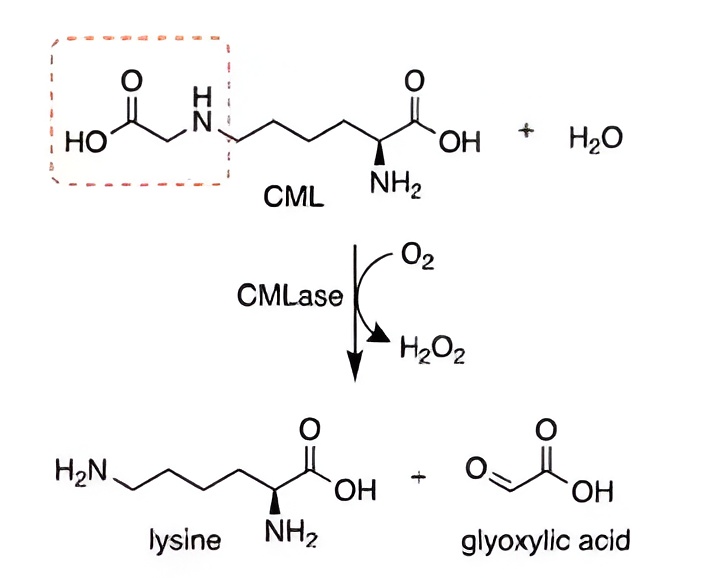
To assess the activity of CMLase on a panel of physiologically relevant proteins, the researchers tested it on proteins including casein (a milk protein), hemoglobin (a protein in red blood cells), collagen (a structural protein in connective tissues), and retinal protein extract, all from sheep. The researchers induced CML modifications on these proteins by treating them with a certain chemical compound called glyoxalic acid. The team then measured CML levels before and after CMLase treatment and found that the enzyme could remove the majority of AGE-associated changes from CML on lysine.
CMLase Drastically Reduced CML in Human Tissues
Since reduced protein function from CML typically occurs in long-lived organisms like humans, short-lived animals like mice are poorly suited for testing CMLase’s capacity to remove CML. This makes testing CMLase’s effects on living animals infeasible.
“If you’re 50, 60, or 70, you’ve had a totally different life experience than a mouse that’s lived for two years. And so, your tissues have had a very different set of damage built up,” stated Cravens.
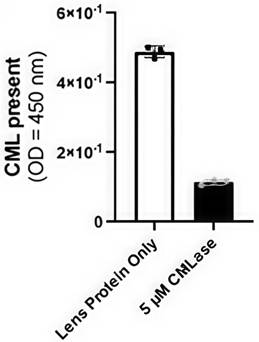
Thus, the researchers tested CMLase on tissues from human donors. They tested the enzyme on aorta, skin, and eye lens tissues (all places of CML accumulation) from donors aged 20 to 25 and compared them to a 75-year-old donor. When they looked for a reduction in CML in these tissues, the results left Cravens a bit surprised.
“We were pretty floored because we were expecting a 20 percent reduction,” he said. “But after these studies, the post-enzyme treatment showed that we were reducing the levels back to that of what we’d see in, like, a 30-year-old’s tissue.”
The Study Provides a Proof-of-Concept for Reversing CML-Related Damage
This new research from Cravens and colleagues addresses a long-standing challenge in aging research—whether cellular damage from AGEs can be reversed. As such, the researchers bioengineered CMLase to enzymatically reverse the buildup of the AGE CML on lysine protein residues, thereby reversing this marker of protein chemical aging.
A key limitation of this research is that the proteins treated with CMLase were highly accessible to CMLase, given that they were treated in thin sections of the proteins from each tissue. Contrastingly, in the context of intact living tissues within an organism, the ability of CMLase to penetrate tissues and effectively eliminate CML needs to be determined. While Cravens and colleagues say that ongoing work in their laboratory is focused on optimizing CMLase activity and adapting its delivery to human tissues, it remains unclear how long it will take for this technology to be applied to humans.
All the same, the directed evolution platform the team used to generate CMLase can be applied to generate other types of enzymes that target other types of AGEs. Since multiple types of AGEs contribute to aging processes, this presents an interesting prospect of targeting multiple age-related protein modifications simultaneously with more than one enzyme to reverse hallmarks of aging associated with AGEs.
“By reversing a hallmark of aging, CMLase provides a powerful tool for dissecting molecular causality and offers a foundation for developing regenerative therapies that repair damaged tissues,” say Cravens and colleagues in their publication.
 Comments