


Key Points:
- Losartan restores metabolite levels in older adults diagnosed with a condition called prefrailty.
- Losartan increases the survival rate of aged mice.
- Previous studies in animal models have shown that losartan extends lifespan.
We may be entering a new era of medicine, where FDA-approved drugs are repurposed to promote longevity. Losartan is prescribed to millions of Americans, but how does it affect older adults without high blood pressure?
Countering Metabolic Aging in Older Adults
In a recent study, researchers from Johns Hopkins University tested the anti-aging effects of losartan on older adults (average age: ~75). Importantly, these older adults did not have high blood pressure or cardiovascular disease. However, they did have prefrailty, a condition described by one or two of the following criteria:
- Unintentional weight loss
- Self-reported exhaustion
- Weak grip strength
- Slow walking speed
- Low levels of physical activity
Prefrailty is the precursor to a condition called frailty, characterized by an increased vulnerability to disability, diseases, and death. In a previous human trial, six months of daily losartan intake was shown to reduce frailty in these prefrail older adults.
The Optimal Dose for Metabolic Health?
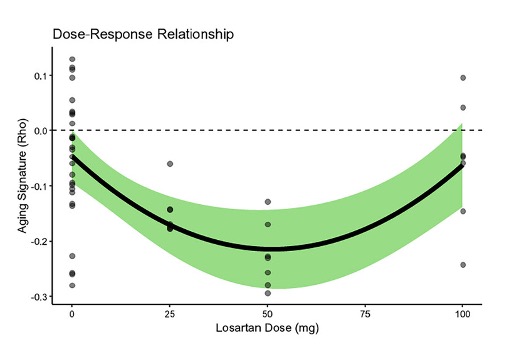
In this study, the researchers analyzed blood samples from the same prefrail older adults. The samples were taken following the consumption of 25 mg/day of losartan for 8 weeks. Based on the concentrations of key metabolites within the blood samples, the researchers developed a metabolic “aging signature.” They found that losartan was associated with a reduction in this aging signature, suggesting a rejuvenating effect on metabolic aging.
In the previous human trial, the dose of losartan was increased every 8 weeks from 25 mg/day to 50 mg/day to 100 mg/day. With this in mind, the researchers analyzed the dose-dependency of the metabolic aging signature. Interestingly, they found that 50 mg/day of losartan had the greatest effect against metabolic aging. These findings suggest that too low (25 mg) or too high (100 mg) a dose of losartan may not strongly counteract metabolic aging in prefrail older adults.
Increasing Mouse Survival Rate
Many factors can accelerate the physical deterioration associated with aging, leading to a shorter lifespan. For example, metabolic dysfunction can accelerate physical deterioration by promoting cell death and chronic inflammation. Persistent metabolic dysfunction, often exacerbated by inactivity and the overconsumption of processed foods, underlies life-shortening diseases, such as obesity, type 2 diabetes, and cardiovascular disease. It follows that reducing the physical deterioration associated with aging can lead to a longer lifespan.
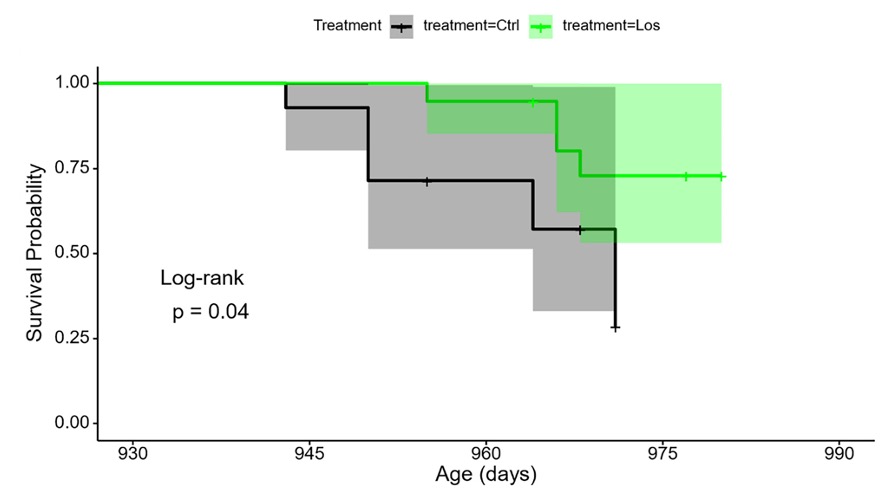
To gain insights into whether losartan can extend lifespan, the Johns Hopkins researchers turned to mice. These mice were 30-months-old, which roughly translates to a human age of 80. Some mice were given losartan in their drinking water for four weeks, while the others drank regular water. Strikingly, all 14 of the mice not given losartan died, while 10 (out of 19) of the mice given losartan survived. These findings show that losartan increases the survival rates of mice. Had the researchers not ended the experiment, they may have observed an increase in total lifespan for the old mice given losartan.
Hacking the System: What Does Losartan Do?
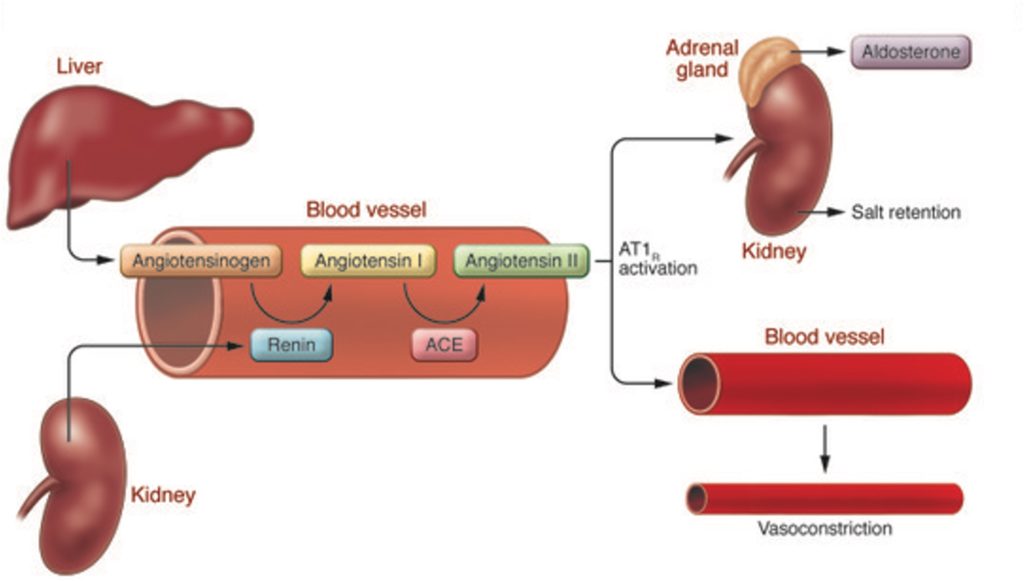
Losartan blocks the angiotensin II type 1 receptor (AT1). For those interested, the following is a more detailed explanation of how losartan and other major blood pressure medications work:
In response to drops in blood pressure, our body compensates through a cascade of molecular events. Various classes of hypertension (high blood pressure) medications target different molecular events along this cascade, known as the RAAS (renin angiotensin aldosterone system).
RASS
Our kidneys produce a hormone called renin when blood pressure drops, or the fight-or-flight response is activated. Aliskiren, a common hypertension medication, can intervene at this point by blocking renin. Normally, renin activates a precursor hormone called angiotensin I. In turn, an enzyme called ACE (angiotensin-converting enzyme) converts angiotensin I into the angiotensin II hormone. ACE inhibitors like lisinopril, which block ACE, are one of the most common types of hypertension medications.
In the adrenal glands atop the kidneys, angiotensin II triggers the release of aldosterone, a hormone that signals the kidneys to retain water and sodium. Angiotensin II also triggers blood vessels to constrict, and both processes promote an increase in blood pressure. Angiotensin II does this by binding to AT1. AT1s are blocked by losartan to alleviate hypertension. Thus, hypertension medications like losartan hack the RAAS to prevent upticks in blood pressure.
Can Losartan Increase the Lifespan of Humans?
Supporting the idea that losartan may extend the lifespan of mammals, a previous study showed that mice lacking AT1, which losartan blocks, live longer than normal mice. Moreover, another previous study showed that losartan extends the lifespan of rats. These rats were given losartan across their entire lifespan, and many lived to the human equivalent age of about 70 to 90, while the untreated rats lived to about 65 (in human years). Considering that administering losartan to humans across their entire lifespan is infeasible, a lifespan study involving larger mammals may support the idea that losartan can increase the lifespan of humans.
 Comments