


Key Points:
- A critical protein modification known as glycosylation is abnormally elevated in the brains of Alzheimer’s patients.
- Increased brain glycosylation from glucosamine promotes memory loss in Alzheimer’s mice.
- Glucosamine supplementation increases the risk of mortality by 25% in Alzheimer’s patients.
Scientists have yet to precisely elucidate the underlying causes of Alzheimer’s disease (AD), the most common form of dementia worldwide. Perhaps due to this lack of understanding, researchers from the University of Florida have found that a common supplement may exacerbate the progression of AD. In a new study published in Nature Metabolism, researchers show that glucosamine supplementation worsens memory and increases dementia-related mortality risk. The findings contribute to a growing understanding of AD progression, whereby the underlying causes remain to be fully uncovered.
Glycosylation Elevated in AD Brains
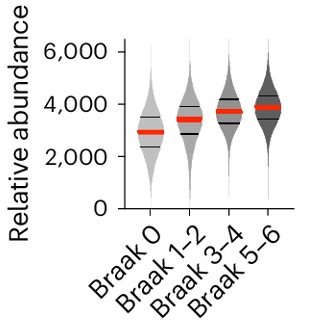
Besides turning it into cellular energy, neurons use glucose to build sugar chains called glycans. When glycans attach to proteins, a process called glycosylation, they modify those proteins. These modified glycosylated proteins play a critical role in the function of neurons, including those neurons involved in learning and memory. However, with dementia, neurons have trouble taking in glucose, and a previous study showed that changes in glycosylation occur within the brains of AD patients. To further explore the effects of glycosylation on dementia, the University of Florida researchers examined brain samples from AD patients. They found that brain glycoslyation increased with each stage of AD. As disease severity increased, so too did the levels of brain glycosylation.
To explore the effects of increased brain glycosylation, the researchers turned to mice that model AD. As opposed to human brain samples, mice that model diseases make it easier for researchers to run experiments on entire organisms. The researchers chose two models, each representing a different type of AD brain pathology:
- 5xFAD mice: AD pathology derived from protein aggregates called amyloid plaques.
- PS19 mice: AD pathology derived the protein aggregates called tau tangles.
Both models showed increased glycosylation levels in regions of the brain associated with memory, cognition, and inflammation. These findings reveal that 5xFAD and PS19 mice recapitulate the increase in brain glycosylation observed in AD patients.
Glucosamine Promotes Memory Loss
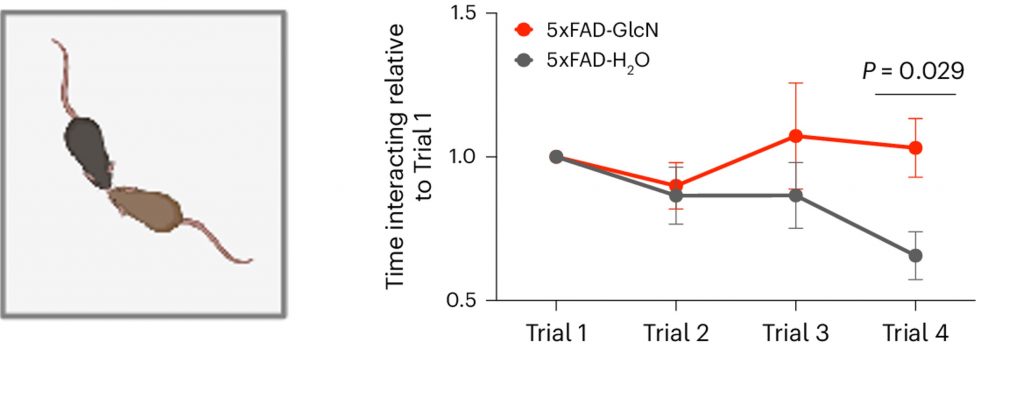
To test memory, the researchers recorded the duration of time the AD mice spent with other mice over four trials. During this test, mice typically spend less time interacting with the same mouse over each successive trial. In contrast, AD mice tend to spend more time, suggesting social memory loss. To test the effect of glycosylation on social memory, the researchers reduced the brain glycosylation levels of the AD mice. Remarkably, they found that reduced brain glycosylation led to improved social memory.
The researchers next tested the effect of increasing brain glycosylation further in the 5xFAD mice. They did so by feeding the AD mice glucosamine, a sugar like glucose used to build glycans. The dose of glucosamine given (457 mg/kg/day) was equivalent to a therapeutic human dose: 2,500 mg/day. As expected, glucosamine increased brain glycosylation. Moreover, glucosamine supplementation increased the duration of time the 5xFAD mice spent with other mice on the fourth trial of the social recognition test.
Glucosamine Associated with Accelerated Brain Aging
Because glucosamine exacerbated memory loss in the 5xFAD mice, the Florida researchers sought to determine if something similar occurs in humans. Since glucosamine is widely used, the researchers were able to find over 24,000 dementia patients who take it regularly. They also analyzed over 40,000 mild cognitive impairment (MCI) patients. Strikingly, they found that glucosamine increased the mortality of dementia patients by 25%. Notably, glucosamine did not impact the mortality of MCI patients. These findings suggest that glucosamine more strongly affects the progression of preexisting dementia.
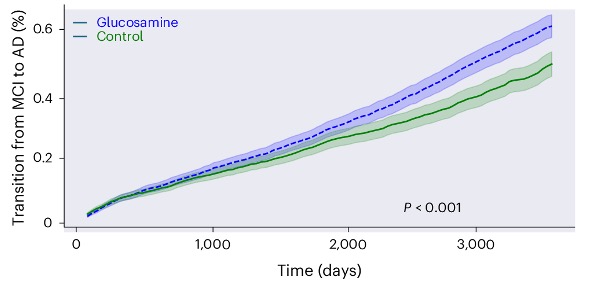
MCI, a less severe form of dementia that doesn’t interfere with daily living, usually remains stable or can be reversed. However, in about 5% of individuals, MCI progresses to dementia, a severe form of cognitive impairment that affects daily living and independence. Alarmingly, the researchers found that MCI patients who took glucosamine were 25% more likely to be diagnosed with dementia. These findings suggest that glucosamine may accelerate the progression of dementia and worsen the disease.
Who Should Avoid Taking Glucosamine
For one of their final experiments, the researchers repeated their glucosamine experiment on non-AD mice, and they found no increase in brain glycosylation or signs of memory loss. This means that glucosamine may only accelerate the progression of dementia in those already afflicted. However, clinical trials testing the effect of glucosamine on the progression of dementia may not be conducted due to ethical concerns. More studies of a similar nature may confirm the results of the University of Florida researchers.
Based on this study, it may be wise for individuals with cognitive impairment or dementia to avoid taking glucosamine. There are other ways of improving joint health, such as performing balancing and stretching movements. Resistance exercise, such as using light weights, body weight, or bands to build strength, can also relieve joint pain. In general, staying active and mobile instead of sitting and remaining sedentary can potentially improve joint health. Since inflammation contributes to joint pain, consuming a diet rich in fruits, vegetables, omega-3s, and other anti-inflammatory foods while avoiding pro-inflammatory foods, like alcohol and processed sugar, may also be advantageous.
 Comments