


Key Points:
- Harvard’s David Sinclair argues that advances in AI-driven medicine and cellular rejuvenation could make 150-year lifespans conceivable for children born today.
- Neuroscientist Jennifer Garrison says closing longstanding gaps in women’s health research is essential to understanding aging and delivering better longevity care for everyone.
TIME Magazine hosted a discussion panel, featured on YouTube, with leading thinkers in the longevity field. Speakers on the panel included Harvard’s David Sinclair (a prominent aging researcher) and neuroscientist Jennifer Garrison (an assistant professor at the Buck Institute for Research on Aging). The discussion rested on the provocative idea that the first person to live to 150 may already be alive. However, a central tension exists behind this premise: significantly extending lifespan is exciting, but extending healthspan—the years lived with energy, mobility, cognitive health, and independence—is more important, according to the panelists.
In addressing the idea of someone alive today living to 150, and longevity science more generally, the panel touched on some major themes. These included cellular rejuvenation, artificial intelligence (AI) in aging research, and women’s health.

Addressing What the “First 150-Year-Old” Claim Means
To begin the discussion, David Sinclair was asked to explain what he meant when he stated, in public interviews, that the first person to live to 150 has already been born. To address this, Sinclair said that children born today may encounter medical technologies that are not yet imaginable, which may make a 150-year lifespan possible. He also emphasized that advancements in medical technology are nonlinear and pointed to the recent rapid advances in AI and its applications to healthcare as an analogy to illustrate this notion.
“The reason that I think we will [see someone live to 150] is because children born today will live into the 22nd century… in the 22nd century, children born today are going to have access to technologies that we literally cannot even imagine now. So, it’s not a straight line. Technology is never a straight line…” reasoned Sinclair.
For clarification, Dr. Sinclair’s view on this subject is a forward-looking prediction, not proof, of course, that current science can make living to 150 possible. Along these lines, having an individual or handful of individuals live to 150 does not equate to increasing the average life expectancy (the estimate of the average number of years a person is expected to live based on current death rates).
Furthermore, record-breaking longevity is not automatically a desirable outcome if added years involve disability, disease, or loss of independence. The preferred outcome for anyone reaching an exceptionally old age is to live longer with an extended healthspan.
Healthspan Over Lifespan: The Panelists’ Consensus Goal for Longevity Research
Aging is increasingly studied as a common upstream driver of age-related diseases, such as heart disease, cancer, and neurodegeneration, because the biological changes that accumulate with age do not affect just one organ. Rather, interconnected changes associated with aging often lead to multi-organ functional decline. Such biological changes weaken cellular repair, metabolic function, immune regulation, and tissue resilience across the body, creating a shared vulnerability that can manifest as age-related diseases. As such, advanced age is the strongest overall risk factor for many age-related diseases.
With respect to researching aging as a key driver of age-related diseases, the panel agreed that extending healthspan trumps merely delaying death through lifespan extension. Accordingly, living to 100 (or even 150) may be meaningful if a person can remain active and engaged, rather than spending decades managing severe age-related illness.
Can Aging Be Reversed? Cellular Rejuvenation Research
Biological age (age as assessed by the functional capacity of cells and tissues) is different from chronological age (the number of years someone has lived). Dr. Sinclair and his colleagues have developed a means to rejuvenate cells in laboratory dishes, as well as naturally aged mice, using a technique called epigenetic reprogramming that reduces biological age.
Epigenetic reprogramming is the resetting of a cell’s epigenetic instructions—the reversible chemical tagging patterns on DNA that determine which genes are active or silent—toward those seen in younger ages. Notably, the resetting of epigenetic instructions occurs without changing the underlying DNA sequence. Researchers can induce this change experimentally to potentially restore some youthful cellular and tissue functions.
Dr. Sinclair induces epigenetic reprogramming via a gene therapy by increasing proteins called Yamanaka factors (named after the 2006 Nobel Prize laureate Shinya Yamanaka). The Yamanaka factors Sinclair uses are the proteins OCT4, SOX2, and KLF4 (collectively called OSK) that can convert mature cells into cells that function more like youthful cells.
In a mouse study, delivery of OSK with gene therapy to retinal ganglion cells (specialized neurons located in the inner surface of the eye’s retina that transmit visual information from the eye to the brain) was associated with improved visual function. Importantly, the mice in this study served as a model for glaucoma (an eye disease that can lead to vision loss and blindness). This study can be understood as an example where the function of certain cells (in this case, neurons) restored a physiological function (vision in this case). As such, it illustrates that, at least in mice, OSK therapy can be used for some regenerative purposes, although it does not demonstrate that aging has been broadly cured.
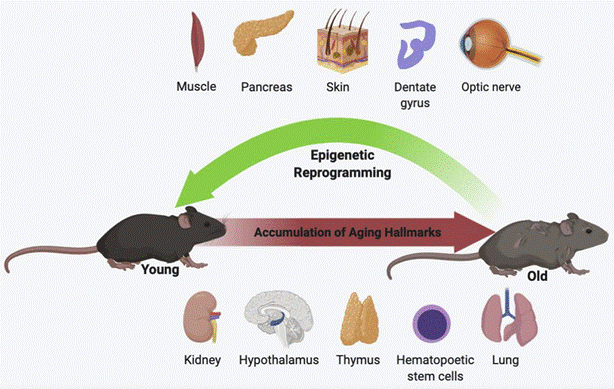
As for epigenetic reprogramming’s effects on lifespan, another mouse study found that OSK delivery via gene therapy extended aged mice’s median remaining lifespan by a whopping 109%. Accordingly, the study suggests that epigenetic reprogramming may work to confer broader effects against aging, aside from rejuvenating tissues and organs.
While the epigenetic reprogramming technique discussed by David Sinclair has conferred positive effects in improving age-related outcomes in animal models, it has not been shown to confer the same effects in humans. The release of data from ongoing human trials will be necessary to discern whether this technique yields some degree of cell and tissue functional restoration and can possibly be used eventually for multi-organ rejuvenation.
How AI Could Accelerate Longevity Science
Also discussed by David Sinclair, AI can help biologists turn overwhelming volumes of genetic, imaging, clinical, and molecular data into prioritized explanations that scientists can test. Its main value is not replacing experiments, but rather helping researchers find significant signals in data, connect evidence across troves of data, predict likely biological mechanisms, and choose the next experiment faster. Along these lines, as Dr. Sinclair cautioned, AI can accelerate research but does not eliminate the need for human trial experimentation and clinical evidence.
Why Women’s Health Is Central to Longevity
Also in the discussion, neuroscientist Jennifer Garrison argued that longevity research has historically failed to study female biology adequately. She stated that we are decades behind in this field of research.
Biological sex differences can arise because every cell develops and operates within a different biological context. For example, sex chromosomes influence gene expression patterns, reproductive organs produce different hormonal environments in the body, and differential hormone levels between the sexes act on tissues, including immune cells, throughout life. These influences interact with age, environment, behavior, social conditions, and medical care to determine one’s biological attributes and health status.
As discussed by Garrison, one key example of biological differences between sexes encompasses the immune system, in which a stronger immune response can be both protective and costly. Women, on average, generate more robust immune responses to infections and vaccines, but that same tendency toward vigorous immune activation can raise the risk of the immune system mistakenly attacking the body’s own tissues.
Garrison argues that women’s health issues, such as ovarian aging, reproductive function, and hormonal changes, should be central, not peripheral, to aging research. This is because excluding them leaves out approximately half of the human population, therefore missing biological mechanisms that could lead to better medicines and healthier aging for everyone. She frames the issue not simply as equity in research participation, but as a scientific opportunity—sex differences extend from visible anatomy down to cellular and molecular biology, creating potentially useful, as-yet-undiscovered targets for understanding and treating disease and developing interventions.
Some of these targets may relate to the female tendency toward stronger immunity. Accordingly, making women’s health issues central to aging research may, more broadly, improve the prevention and treatment of age-related diseases for all people.
An Extended Healthspan Should Accompany a Longer Lifespan
A 150-year lifespan is possible to imagine, but it remains speculative. Even if some humans achieve a 150-year lifespan and average life expectancy increases in the not-so-distant future, perhaps the best measure of progress will be whether we can extend people’s healthspans. As always, the best way to approach lifespan and healthspan extension is to embrace scientific optimism but also demand strong evidence on choices (whether supplements, medicines, or other techniques) that improve healthy aging while research continues. The future of longevity may be extraordinary, but the most valuable breakthrough is one that gives people more good years, not merely more years.
 Comments