


Key Points
- Daily krill oil supplementation protects muscle mass, grip strength, endurance, and muscle fiber size in mice exposed to accelerated aging.
- Krill oil outperforms fish oil despite providing roughly equivalent amounts of the omega-3 fatty acids EPA and DHA.
- Krill oil protects mitochondria through AMPK, a cellular energy sensor involved in mitochondrial maintenance and muscle health.
Skeletal muscle accounts for roughly 40% of body mass and serves as the body’s largest reservoir of protein. Aging progressively disrupts the mitochondria that supply muscle cells with energy, contributing to declining strength, mobility, and eventually sarcopenia (the age-related loss of muscle mass, strength, and function). Sarcopenia affects an estimated 10–16% of adults over 65 and substantially increases the risks of falls, disability, hospitalization, and death.
Exercise remains one of the most effective ways to preserve muscle with age, but researchers continue to investigate whether nutritional interventions can complement physical activity. Krill oil contains the omega-3 fatty acids EPA and DHA, similar to fish oil, but carries much of these fats in phospholipids, fats that form the membranes surrounding cells, rather than triglycerides, the primary form in which the body stores fat. It also contains astaxanthin, an antioxidant that can accumulate in cellular membranes.
A new study published in npj Science of Food found that Antarctic krill oil protected muscle mass and physical function in mice exposed to experimentally accelerated aging. Krill oil also outperformed conventional fish oil and protected mitochondrial processes that deteriorate with age.
Krill Oil Preserved Muscle Strength and Endurance
Researchers administered D-galactose to mice daily for 12 weeks to induce oxidative stress, mitochondrial dysfunction, muscle loss, and other features of accelerated aging. Separate groups received either krill oil or fish oil at 400 mg/kg of body weight each day. The supplements provided roughly equivalent doses of EPA and DHA, allowing a direct comparison.
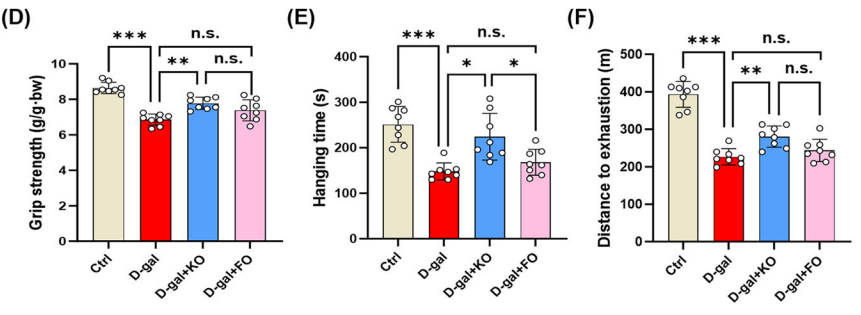
D-galactose reduced grip strength, shortened the amount of time mice could hang from an inverted grid, and decreased the distance they could run before exhaustion. Krill oil significantly protected against declines in all three measures of muscle function, while fish oil did not produce significant improvements.
Krill oil also preserved lower-limb lean mass and reduced muscle loss in four of the five muscles examined. Muscle fibers remained larger in treated mice, providing structural evidence that krill oil protected against muscle atrophy in addition to maintaining physical performance.
Krill Oil Protected Aging Mitochondria
The researchers next examined mitochondria because their decline contributes to age-related muscle loss by reducing ATP production and increasing damaging reactive oxygen species. Aging also impairs mitochondrial quality control, the system that maintains healthy mitochondria and removes damaged ones.
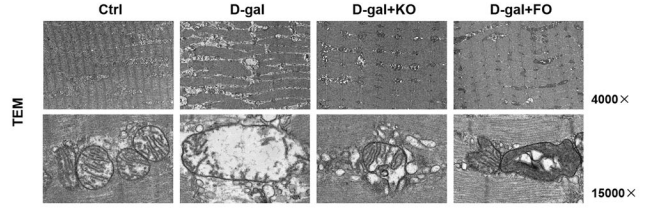
D-galactose produced swollen and damaged mitochondria in skeletal muscle, including disrupted internal membranes and reduced mitochondrial abundance. Krill oil reduced these abnormalities and prevented mitochondrial loss in both mouse muscle and cultured muscle cells. It also protected mitochondrial membrane potential, an indicator of mitochondria’s ability to maintain the electrical gradient required for ATP production.
Krill oil also reduced oxidative stress (the buildup of harmful, reactive molecules in cells), DNA damage, and apoptosis in skeletal muscle. Several markers of cellular senescence (a dysfunctional state where cells can emit inflammatory molecules) increased after D-galactose exposure and declined following krill oil treatment.
AMPK Was Necessary for Krill Oil’s Effects
The researchers traced many of these mitochondrial benefits to AMPK, an enzyme that senses changes in cellular energy availability. AMPK helps coordinate mitochondrial production, repair, and recycling while regulating how cells respond when energy becomes scarce.
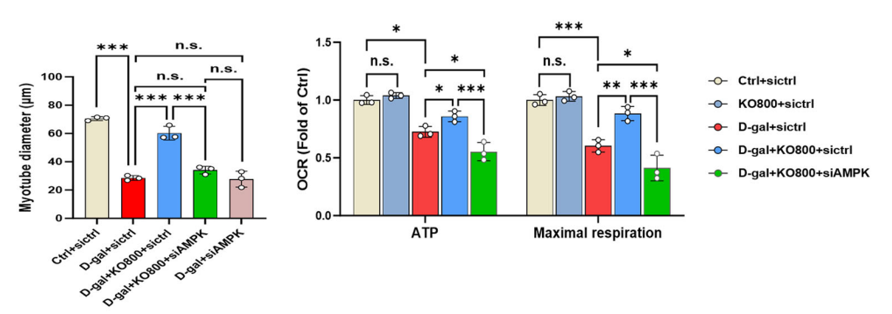
Krill oil restored AMPK activity that D-galactose had suppressed and preserved several components involved in mitochondrial quality control. The researchers then reduced AMPK expression in muscle cells to determine whether the pathway actually caused these effects.
Without sufficient AMPK, krill oil could no longer prevent muscle-cell shrinkage or mitochondrial damage. AMPK suppression also weakened krill oil’s ability to restore cellular energy in the form of ATP molecule production and maximum mitochondrial respiration, and eliminated several of its effects on oxidative stress and cell death.
Krill Oil and Fish Oil Produced Different Results
Krill oil’s stronger effects were particularly notable because both supplements contained similar proportions of EPA and DHA. The two oils package those fatty acids differently. Krill oil carries much of its EPA and DHA in phospholipids, which can facilitate their incorporation into cellular membranes.
The researchers found greater accumulation of EPA and DHA in skeletal muscle after krill oil treatment than after fish oil treatment. Krill oil also contains astaxanthin, which fish oil lacks and which has antioxidant activity within mitochondrial membranes. These differences could help explain why krill oil preserved physical function while fish oil did not, although the experiment cannot determine which individual component produced the advantage.
Maintaining Mitochondria Could Help Preserve Muscle With Age
Age-related muscle loss threatens longevity partly because losing strength makes everyday movement progressively more difficult. Large prospective studies have associated sarcopenia with roughly twice the risk of death, while declining strength increases the likelihood of falls, fractures, disability, and loss of independence.
Mitochondrial deterioration may contribute to this progression before severe muscle loss develops. Aging leads to reduced ATP production and the disruption of systems that replace damaged mitochondria, while accumulated oxidative damage accelerates muscle protein breakdown. The researchers also analyzed human muscle data and found that several genes involved in mitochondrial quality control were expressed at lower levels in older adults than in younger adults.
Krill oil already has an advantage that many experimental longevity interventions lack: people can readily purchase and consume it. The mouse dose corresponded to a calculated human-equivalent dose of approximately 1.98 grams of krill oil for a 70-kilogram adult. This conversion does not establish an effective human dose, and researchers have not shown that krill oil prevents age-related sarcopenia in people.
The study also used young mice exposed to D-galactose rather than naturally aged animals. D-galactose models oxidative stress and several features of accelerated aging but cannot reproduce the full biological complexity of decades of human muscle aging. Studies in naturally aged animals and older adults will need to determine whether krill oil can preserve the strength and mobility that ultimately matter for healthy aging.
 Comments