


Key Points:
- As David Attenborough’s 100th birthday approaches, reviewing his lifestyle habits for longevity may provide aging adults with examples they can incorporate into their routines.
- These simple habits include not eating much meat, having a sense of purpose, eating small meals, spending time in nature, and maintaining strong social connections.
Sir David Attenborough is a British broadcaster, writer, and natural historian known for his landmark nature documentaries and environmental advocacy. He began his career in the 1950s, becoming one of the most recognizable voices in wildlife television. He is also widely known for promoting conservation and climate action.
One remarkable thing about Attenborough is his age. Born May 8, 1926, he will soon turn 100, making him a soon-to-be centenarian.
Some of David Attenborough’s Lifestyle Habits Overlap with Common Practices in Blue Zones
Many reasons likely underlie Attenborough’s remarkable longevity. For example, a genetic component may play a role; his father, Frederick Attenborough, lived to 85. However, genetics may not be the only factor, since Attenborough shares key lifestyle habits with people who live in the world’s Blue Zones—regions known for having higher proportions of the population that live exceptionally long.
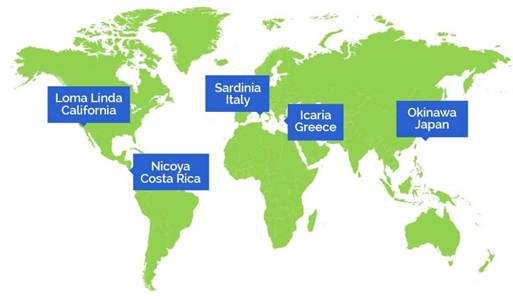
It is not uncommon for people in Blue Zones to reach their 90s and even 100s without developing age-related conditions like heart disease or metabolic complications. Because of Attenborough’s astonishing age, identifying what lifestyle habits he adheres to that overlap with those common in Blue Zones may help unravel how he has managed to live so long. Reviewing these habits can also provide examples of practices aging adults can follow to live longer in the best state of health possible.
David Attenborough Does Not Eat Much Meat
One common feature of Blue Zones is that people living in them often center their diets on plant-based whole foods, with lower meat consumption compared to Western diets. Similarly, while David Attenborough is not fully vegan or vegetarian, he does not consume protein from animals often. This lifestyle trait may have arisen, in part, from his vocal criticism of the meat industry.
“The planet can’t support billions of meat-eaters,” he said in 2020. “If we all ate only plants, we’d need only half the land we use at the moment.”
When David Attenborough does consume meat, he eats small amounts of fish and chicken. However, he has said that he actively avoids eating red meat, such as beef, pork, and lamb.
“I do eat cheese, I have to say, and I eat fish. But by and large, I’ve become much more vegetarian over the past few years than I thought I would ever be,” he continued.

David Attenborough Has a Strong Sense of Purpose
A key characteristic of Blue Zones is that people living in them often have a strong sense of purpose. For example, in the Blue Zone of Okinawa, Japan, a sense of purpose is commonly referred to as ikigai, which roughly translates to “a reason to wake up in the morning.” Along these lines, the sense of purpose that ikigai denotes may involve family, community, or personal passion.
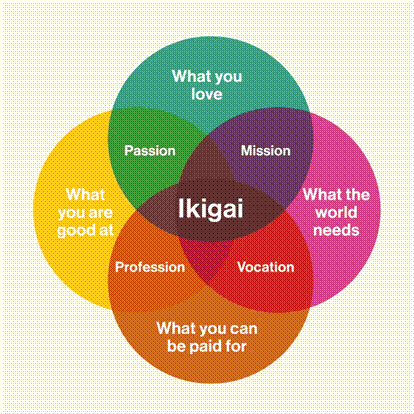
Things David Attenborough has done during his career serve as an example of this principle. Since the 1950s, Attenborough has served as an educational beacon with a deep commitment to teaching the public about the natural world and advocating for its protection. As he approaches his 100th birthday, he remains actively engaged in these endeavors, which fall in line with the concept of ikigai.
David Attenborough Eats Small Meals
Another common habit of people in Blue Zones is their consumption of small meals that contain an abundance of plant foods. Another example for Okinawa is the rule of Hara Hachi Bu, which advises stopping eating when someone is about 80% full. This rule helps David Attenborough to avoid overeating.
“I’ve never really been one for eating enormous meals, and I’m not particularly a gourmet either, so I can’t pretend that I’m feeling deprived in any way or that it’s cost me all that much,” he has said.
David Attenborough Spends a Significant Amount of Time in Nature
Many people in Blue Zones incorporate natural movement into their daily routines, rather than engaging in intense workout routines. Along these lines, they may garden, go walking, or work around the home. Often, they also focus on managing stress through a connection to nature.
Although Attenborough no longer makes long treks through natural surroundings, as he did during his younger years, he still makes time for nature walks. During these walks, he engages in quiet observation in an effort to promote mental well-being.
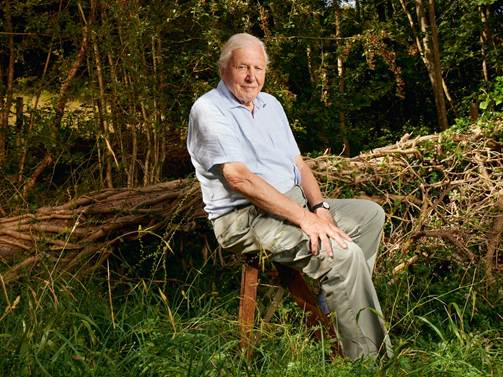
“Sit down. Don’t move. Keep quiet. Wait ten minutes. You’ll be very surprised if something pretty interesting didn’t happen. Doing that in a woodland, if you haven’t done it, it’s extraordinary. Don’t get too impatient, either,” said David Attenborough.
David Attenborough Maintains Strong Social Connections
One lifestyle factor that many people in Blue Zones share is a strong sense of community and social connection. Research shows that these factors are linked to a reduced risk of early death.
In line with older people having a sense of community and social connection, in Blue Zone regions of Sardinia, Italy, and Nicoya, Costa Rica, younger people have a deep respect for elders, who play an important role in family life. Moreover, elders are not isolated or cast out of social circles, but rather, are seen as sources of wisdom and experience.
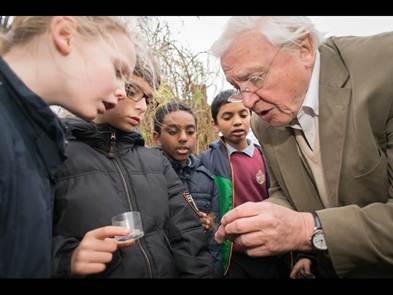
Similarly, David Attenborough often collaborates with younger generations of scientists and filmmakers, who value his work and have a deep sense of respect for him. Attenborough has also narrated films aimed at younger generations and has mentored younger naturalists. Through his interactions with younger generations of people in his field, Attenborough has managed to maintain social connections and a sense of community.
Research Suggests that Lifestyle Factors May Contribute About as Much to Lifespan as Genetics
Following David Attenborough’s lifestyle habits, which overlap with those common to many living in Blue Zones, may aid in the effort to live longer and possibly reach the age of 100. While genetics may play a strong role in Attenborough’s remarkable longevity, eating low quantities of meat, having a sense of purpose, eating small meals, spending time in nature, and maintaining social connections likely contribute as well.
Accordingly, some research suggests that lifestyle factors, like diet and exercise, may have about the same influence on lifespan as genetics. Moreover, the same research also suggests that adhering to optimal lifestyle habits adds 10 or more years to a person’s life.
 Comments